Blakeney
The charming village of Blakeney lies on the North Norfolk coast between
Morston and Cley.
It was once an flourishing sea port but, over the
centuries, its harbour silted up and today only small
boats can enter. In his poem
Blakeney -
Thomas Thornely (1855-1949) - laments the decline of the
town's trading links:
|
|
Those days are gone. There sound no
more
The capstan song, the welcoming hails,
As some stout trader, fraught with bales
From Eastland marts, draws near the shore.
For not to Anglian ports today
Turns England with her swollen needs |
|
Jack Higgins
(1929 - )
Higgins did the research for his novel The Eagle Has Landed
(1975)
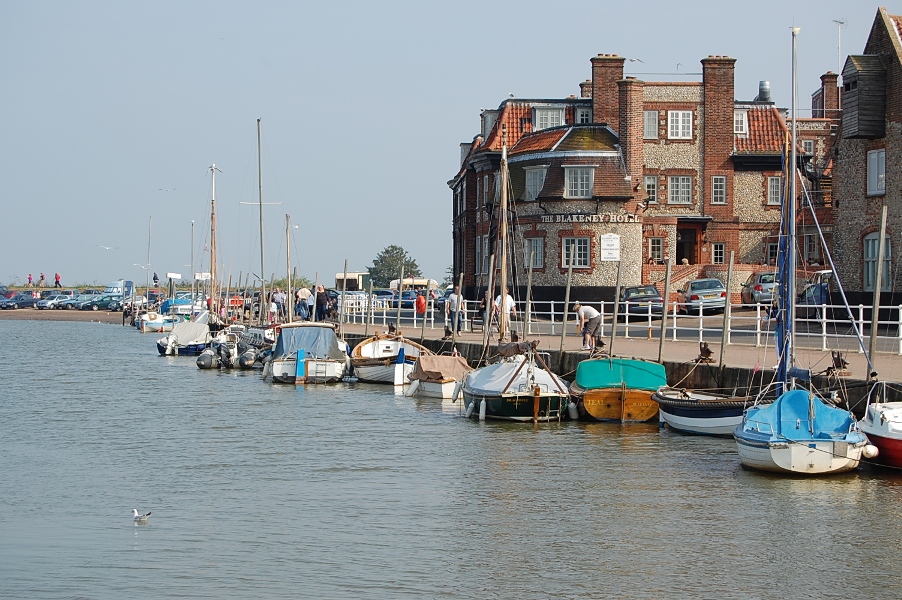
while staying in the Blakeney Hotel. The book tells the
story of a group of German paratroopers who land in
England during WW2 and attempt to assassinate
Winston Churchill while he spends a weekend in North
Norfolk.
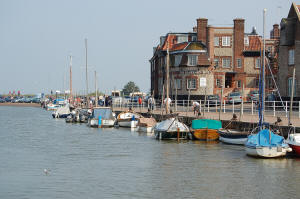 Blakeney Hotel
The novel begins in the churchyard of St. Mary and
All Saints in the fictional village of Studley
Constable. Higgins (the narrator) is here looking for
the grave of a 17th Century sailor called Charles
Gascoigne but instead comes across the hidden burial
site of Colonel Kurt Steiner - a paratrooper - who was
killed in action in 1943. This provides the catalyst for
the rest of the novel's dramatic story line. Studley
Constable church was probably modelled on
Salthouse or Cley - as both have headstones with spooky engravings.
Here is Higgins' description from the book:
|
|
'I worked my way through methodically, starting at the
west end, noticing in my progress the headstones he'd
mentioned. They were certainly curious. Sculptured and
etched with vivid and rather crude ornaments of bones,
skulls, winged hourglasses and archangels.' |
In 1976 the novel was made into a film - directed by
John Sturges and starring Michael Caine, Donald
Sutherland, Donald Pleasance and Robert Duval.The North Norfolk coast has always
been at risk of invasion through out the centuries -
particularly at Weybourne Hope where there is deep water
close inshore. Today the cliffs and beaches are still littered with WW2 pill
boxes and tank traps.
During WW2, Winston Churchill used to stay at the Sea
Marge Hotel in Overstrand -
and this may have provided Higgins with the inspiration
for his novel.
Richard Mabey (1941- )
In the late1960s, the nature writer Richard Mabey used to
visit Blakeney - staying with friends in a converted
lifeboat moored in the harbour. He became fascinated by
the salt marshes and the muddy creeks here and later
rented a cottage in the village. Expeditions
to gather edible plants such as samphire, fennel and
wild spinach inspired
him to write his iconic book Food for Free -
which was published in 1972. Mabey has been quoted as
saying: 'A lot of the book was written up
there......It's very much a Norfolk book.' It was also returning to Blakeney later in his life
- when he was suffering from
severe depression - that prompted him to move permanently
to Norfolk - leaving behind his beloved Chiltern hills.
In another of his books - Home Country (1990)
- Mabey summed up his feelings for the north Norfolk
coast as follows:
|
|
'I sometimes wondered if the closeness of these unstable
edges of the land was part of the secret of Norfolk's
appeal to us, a reflection of a half-conscious desire to
be as contingent as spindrift ourselves, to stay loose,
cast off, be washed up somewhere unexpected. Down among
these shifting sands the world seems to be all
possibility.' |
|
Patrick Hamilton (1901-62)
The novelist and playwright
Patrick Hamilton had his ashes scattered at Blakeney Flats. Hamilton died of an alcohol-related
illness at a house called Martincross in
Sheringham.
|
Links:
More Blakeney photographs |

 Supported
by Norfolk Tourism
Supported
by Norfolk Tourism