Diss
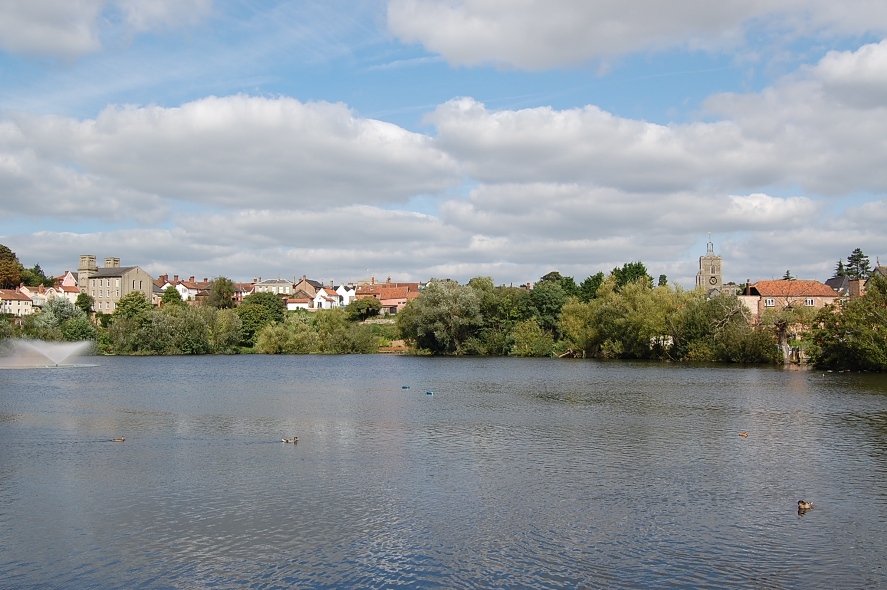
Diss is a delightful market town located on the
Norfolk-Suffolk border. It gets its name from 'Dic'
or 'Disce' - which was Saxon for 'ditch of standing
water' and has been variously known as Dice, Dysse, Dis,
Dic, Disce, Dize and Disze. The town is built around the
Mere - a six acre lake which is fed by underground
springs.
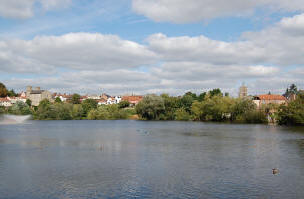
Diss Mere
Diss is famous for its links with two poet laureates:
John Skelton and Sir John Betjeman.
John Skelton (?1460-1529)
Skelton was born in the town
and became the rector of St. Mary's Church in 1504 - a
position he held until his death. After 1511, however,
he spent much of his time at court in London where,
despite his outspokenness, he enjoyed royal favour. He
was created poet laureate by the universities is Oxford
and Louvain.
Skelton's poetry is famous for its short lines and tumbling
rhymes which subsequently became known as 'Skeltonic
Verse' or 'Skeltonics'. W.H. Auden and Robert Graves
were both admirers of his work - though Pope referred to
him as 'beastly Skelton'. In some ways, his work is
similar to modern rap.
His poem Ware the Hawk,
which
tells the story of a parson who illegally flew his
hunting hawk inside St. Mary's church in order to catch
pigeons, demonstrates some of these rattling rhymes.
Here is an extract:
|
I shall you make relation,
By way of apostrophation,
Under supportation
Of your patient toleration,
How I, Skelton Laureate
Deviséd and also wrate
Upon a lewd curáte,
A parson beneficéd,
But nothing well adviséd.
He shall be as now nameless,
But he shall not be blameless
Nor he shall not be shameless;
For sure he wrought amiss
To hawk in my church of Diss.
Read complete poem |
Characters from Diss also inspired his poems The
Epitaph of Adam Udershall and A Devout Trental
for Old John Clarke.Skelton once horrified his
congregation at St. Mary's by turning up with a common
law wife and a child born out of wedlock.
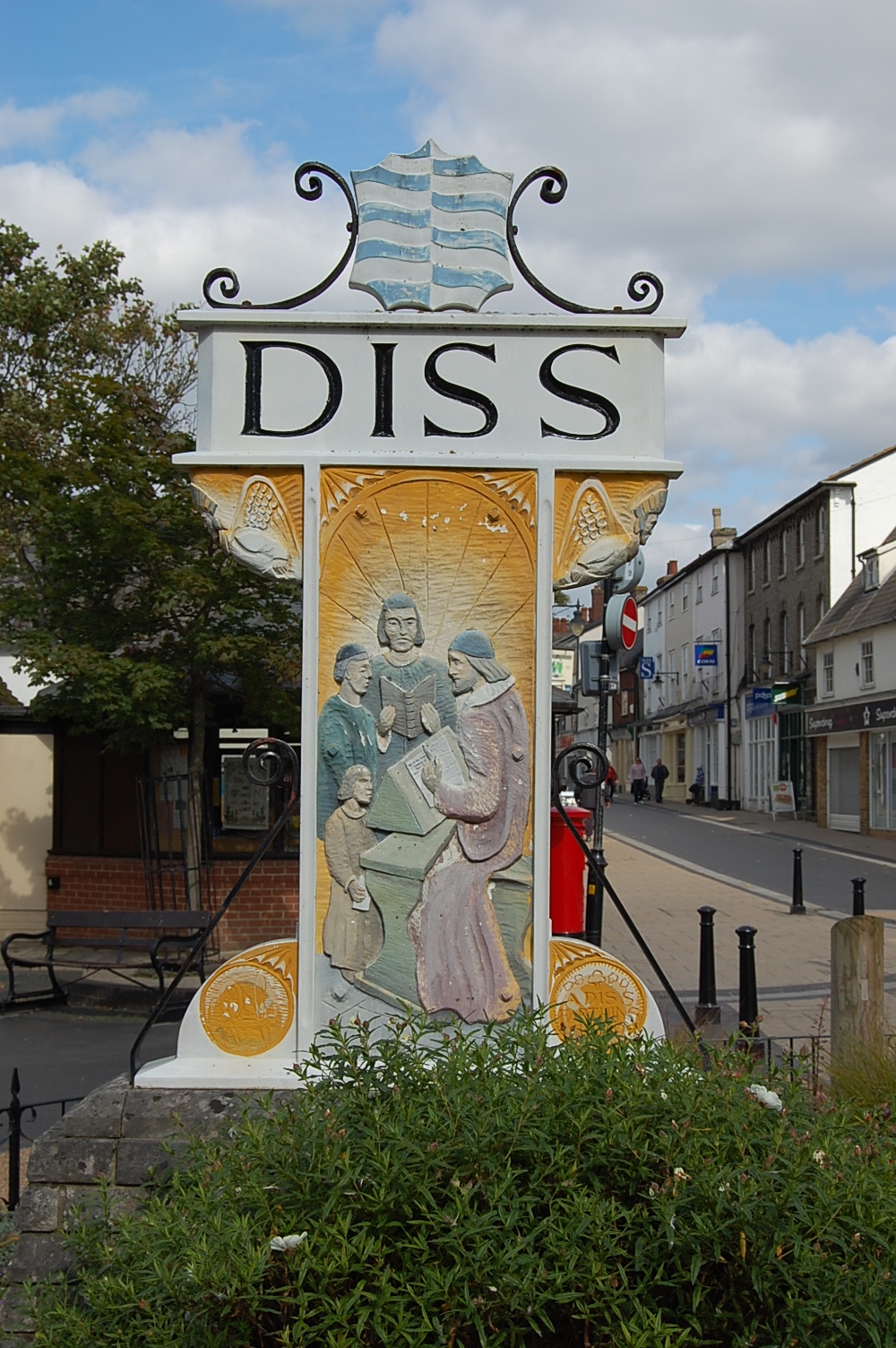
The town sign,
located next to the Mere, depicts him teaching Prince Henry
- later Henry VIII.
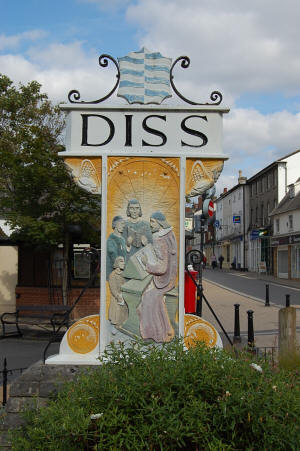
Diss Town Showing -
Showing John Skelton
See also Norwich
|
|
John Betjeman (1906-84) Betjeman first came to Diss in 1963 when he was
filming a series about English market towns for the BBC.
He knew little about the town originally but it soon
became one of his favourites.
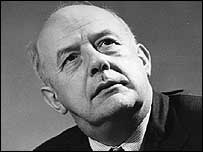
Sir John Betjeman
The programme, which was first broadcast in 1964,
began as follows:
|
|
'Ah, Norfolk, Diss. Here's the station. Where's Diss?
All I know about Diss, up to date, is that it's near the
headquarters of the British Goat Society. That's all I
know at the moment. I must go and find Diss.' |
The programme also mentions Skelton, calling him 'the
poet of birds, beasts, flowers, love and jokes'.The
town also inspired Betjeman's well-known
poem A Mind's Journey to Diss
which is addressed to Harold Wilson's wife Mary who grew
up in the town. The poem records an
imaginary journey from Liverpool Street train station in
London - out through the suburbs - and on northwards
through the countryside of East Anglia. In classic Betjeman style, it
captures many topographical features along the way
including church-towers, maltings and quays before
finally drawing to a close at Diss station.
|
Dear Mary,
Yes, it will be bliss
To go with you by train to Diss,
Your walking shoes upon your feet;
We'll meet, my sweet, at Liverpool Street.
That levellers we may be reckoned
Perhaps we'd better travel second;
Or, lest reporters on us burst,
Perhaps we'd better travel first.
Above the chimney-pots we'll go
Through Stepney, Stratford-atte-Bow
And out to where the Essex marsh
Is filled with houses new and harsh
Till, Witham pass'd, the landscape yields
On left and right to widening fields,
Flint church-towers sparkling in the light,
Black beams and weather-boarding white,
Cricket-bat willows silvery green
And elmy hills with brooks between,
Maltings and saltings, stack and quay
And, somewhere near, the grey North Sea;
Then further gentle undulations
With lonelier and less frequent stations,
Till in the dimmest place of all
The train slows down into a crawl
And stops in silence.....Where is this?
Dear Mary Wilson, this is Diss. |
Thomas Paine (1737-1809)
The radical pamphleteer, who was born at
Thetford, spent a year of his
life in the town working as a staymaker. |
Roger Deakin (1943-2006)The environmentalist
and nature writer, who lived at nearby Mellis Common,
was an English teacher at Diss High School for three
years. Deakin, who is celebrated for his books
Waterlog (1999) and Wildwood (published
posthumously in 2007), was an exponent of wild swimming
and frequently swum in the
River Waveney. He tragically died at the age of 63
at the height of his creative powers. He was also an
inspirational teacher and used to receive visits from
his ex-pupils through out his life. |
Links:
More photographs of Diss
Skelton's Grave |
|

 Supported
by Norfolk Tourism
Supported
by Norfolk Tourism