|
|
|
|
Happisburgh
Happisburgh (pronounced 'Hazeburrer' or 'Hazebruh') lies on the
Norfolk coast between Walcott and
Sea Palling. It is
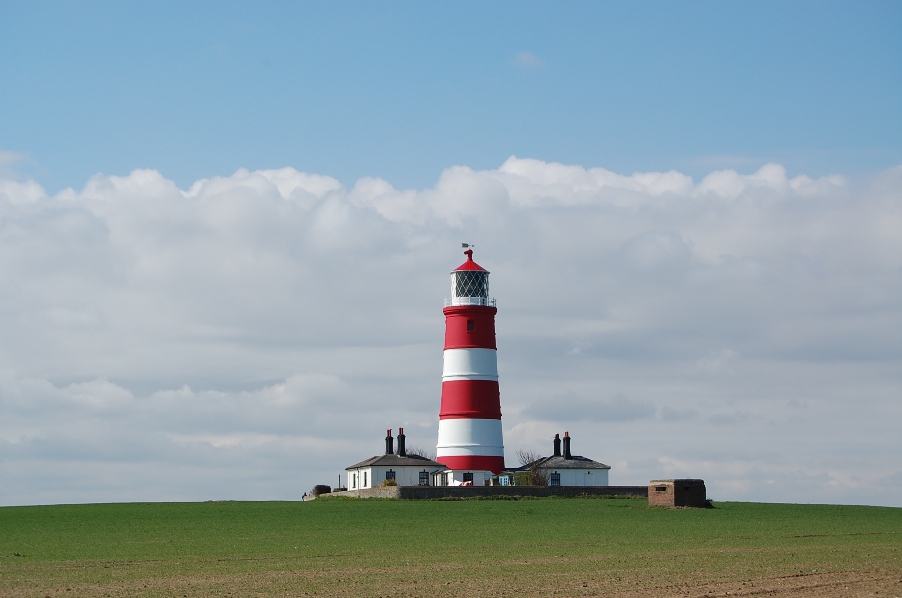
famous for its red and white striped lighthouse, its
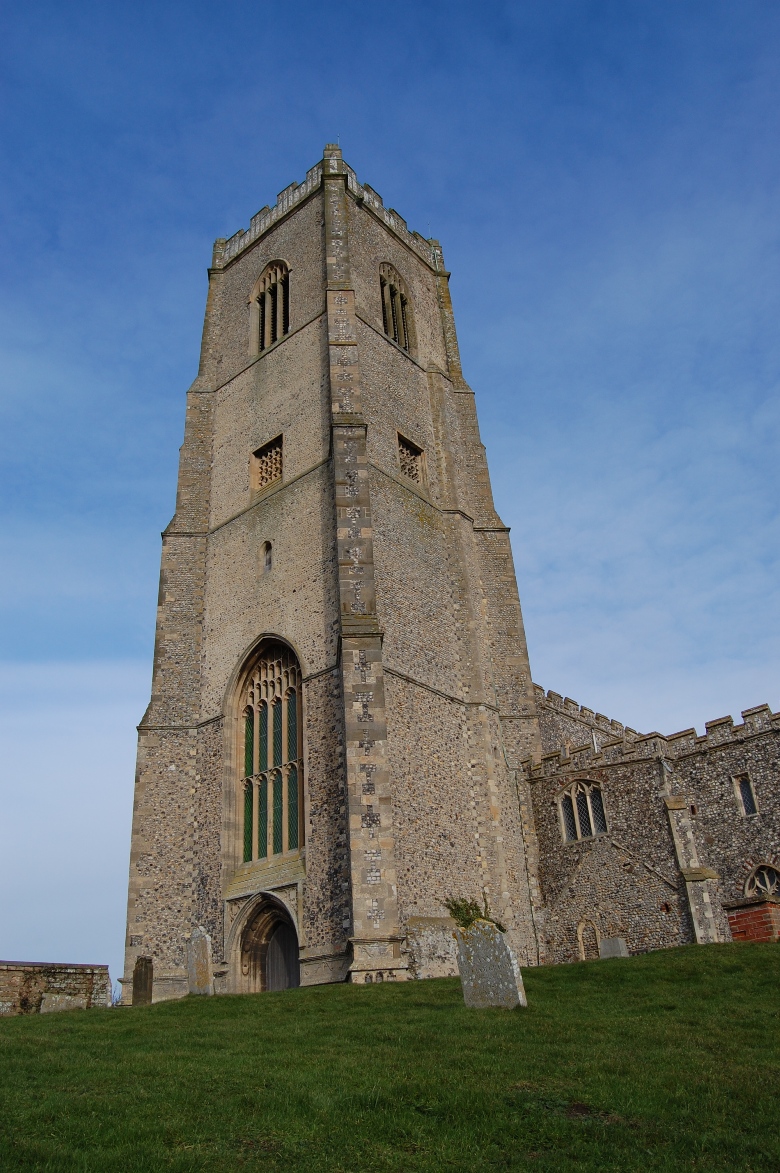
rapidly eroding cliffs and its lofty church tower. The
name is derived from 'Haep's Burgh'.
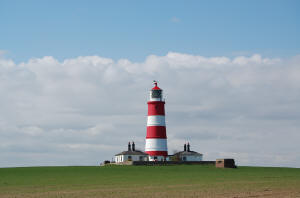
Happisburgh Lighthouse
|
|
William
Cowper (1731-1800) The poet and hymnodist William
Cowper used to visit St. Mary's Church when he was a child
staying with his uncle and aunt Donne at
Catfield Rectory.
Later in life he returned to the village while he was
lodging with his cousin the Rev. Dr. John Johnson at
nearby
Mundesley. (The house in
Mundeslely is now called Cowper House.) The church
stands on a hill close to the coast and its 110 foot
tower can be seen for miles inland.
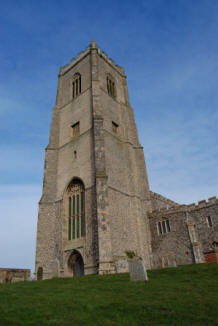
St. Mary's Church, Happisburgh Cowper made two visits to Happisburgh,
at this time, and here are some
extracts from Rev. Johnson's journal recording the
trips:
|
Aug. 31st, 1795. Walked to Happisbugh by the edge of the
sea all the way. Dined in a Lodging House, where I
borrowed a room for the purpose, to avoid the noise of
the Public House and after dinner returned to Mundesley.
This was the only instance of Mr. Cowper's ever eating,
as he told me afterwards, with anything like an
appetite, in Norfolk; and to be sure, he did eat very
heartily, though of very ordinary food, for the only
things he would touch were Beans and Bacon, which were
very old, and apple pye, the worst I ever saw. He ate,
however, with a most complete relish of them all. I
never knew him to enjoy a dinner anything like it after
that, to the day of his death.
June 7th, 1798. I coaxed him to day into a boat in which
he and I and our servant were rowed to Happisburgh. He
went with me to see the Light House and appeared to
enjoy in some measure looking thro' a telescope from
that very lofty building, at the ships in the offing.
After dining at the Public House on the Hill, we walked
home - the sea being too rough for us to venture in the
boat. |
However, living close to the sea irritated Cowper's eyes
(as he records in one of his letters to Lady Hesketh)
and ultimately he decided to move inland to
Little Dunham. Cowper's
bleak late poem The
Castaway was written in Norfolk at this time and
may have been inspired by the coastline at Happisburgh. Some
commentators have also suggested that it was the sea at Happisburgh which
inspired his famous lines from the Olney Hymns:
|
God moves in a mysterious way,
His wonders to perform;
He plants his footstep on the sea,
And rides upon the storm. |
|
Sir Arthur
Conan Doyle (1859-1930)
Sir Arthur Conan Doyle
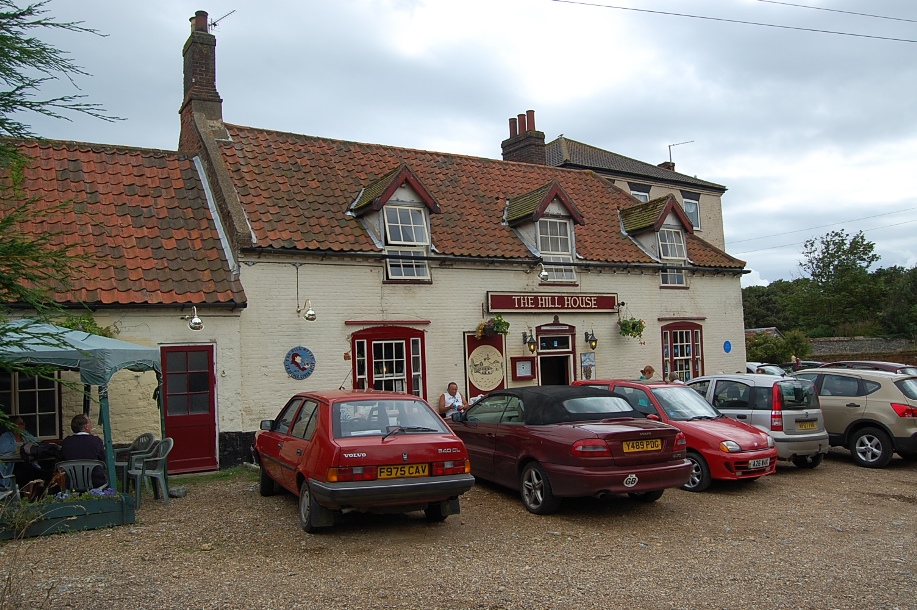
visited the Hill House Hotel while on a motoring holiday
in the county in 1903. While staying in the hotel, the
landlord's son, Gilbert Cubitt, apparently
showed him a signature he had developed using pin men.
This inspired Conan Doyle to write the Sherlock Holmes
story The Dancing Men.
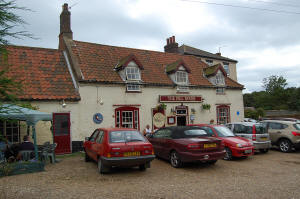
The Hill House Pub In the story, Holmes and Watson are called to
Norfolk by Hilton Cubitt, a local squire, to investigate
a mystery. Holmes eventually solves the case by cracking
a code which consists of little dancing figures -
similar to those of Gilbert Cubitt. As can be seen,
he also took the name Cubitt from his visit. Another local link is that Cubitt lives in the
manor at Ridling Thorpe - which is almost certainly a
composite of local villages Ridlington and
Edingthorpe. Conan Doyle
may have written the story in the Green Room of the Old
Boarding House which overlooked the bowling green. The
villain in the story - an American by the name of Abe
Slaney - lodges in a farmhouse at nearby East Ruston.
|
|
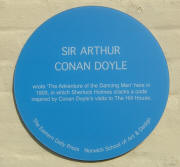
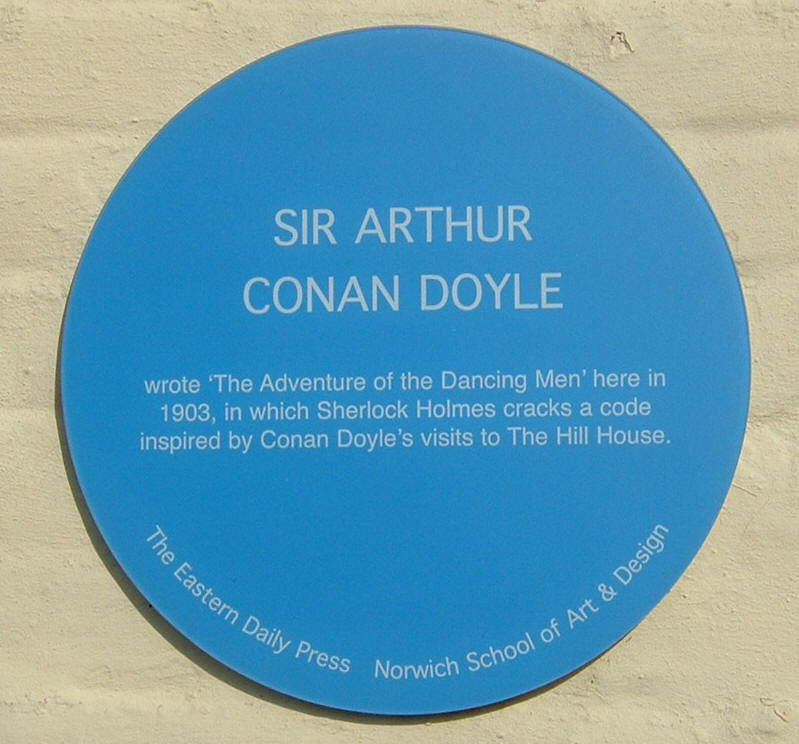
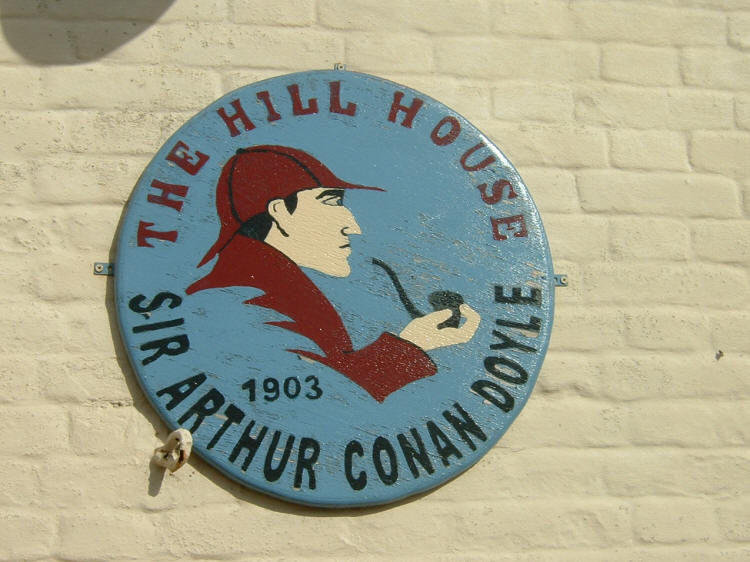
Plaque on Hill House
Pub |
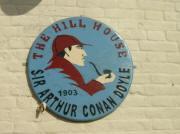
Plaque on Hill House
Pub |
Today the Hill
House is a pub and has two plaques on the wall commemorating Conan Doyle's stay.
It also holds a rather fine 'summer solstice' beer
festival every year. At the back of the pub is an
interesting building which was originally a signal box
for a railway line that was never built.The pub also
has another literary link because the landlord, Clive
Stockton, is the brother of Lorna Sage (1943-2001). Sage (nee
Stockton) is best remembered for her moving memoir
Bad Blood. She worked for many years in the English
department at the
University of East Anglia. There are photographs of
her above the fireplace inside the pub. |
P.D. James (1920-Happisburgh lighthouse also features in P. D. James' 1989 crime
novel Devices and Desires. Dr Alex Mair, who is
the director of the fictional Larksoken nuclear power
station often sees the beam from the lighthouse while
working late in his office. In the novel Commander
Dalgliesh - who initially comes to Norfolk on holiday -
finds himself embroiled in the hunt for a serial killer
called the 'Whistler'.
|
|
John Betjeman (1906-84) The poet John Betjeman
visited Happisburgh church in 1974 when he was making
the 1974
BBC documentary A Passion for Churches. He was impressed
by the window of St, Mary's and also noticed that the
tower was out of alignment with the nave.
|
|
Joan Barton (1908-86) The poet Joan Barton wrote a moving
poem about Happisburgh called Thoughts at Happisburgh.
Barton, who was a bookshop owner for much of her life,
was born in 1907 and her poetry has echoes of Philip
Larkin and John Betjeman. Here is the first verse of the
poem:
|
Remember the long combes tunnelling into summer
Cumulus tossed into towers and keeps above,
The trampled cliff paths sweet with gorse and bracken
Around each known, each named, particular cove,
And by this touchstone from the years of promise
Happisburgh cracks in dry impersonal pieces -
The reeds, the marram grass, a north wind whipping
The anonymous flat sea margins, the huts, some caravans,
And over it all the sky enormously drifting
In endless thin layers of cloud: undesired
Featureless landscape where the intruding figures
Loom up too large and loud.
Read
complete poem |
Happisburgh Haiku
From 2018-19,
I collaborated with the photographer Stephen Hyatt-Cross
to produce a series of haiku about Happisburgh. The
sequence attempted to capture the village's ongoing
battle with coastal erosion. We were also able to
document, in words and pictures, the abandonment of the
Manor Park Caravan site. The full sequence can be seen
here:
Happisburgh Haiku. |
Links:
More Happisburgh Photographs
More Norfolk Sherlock Holmes photos
|
|
|
|

 Supported
by Norfolk Tourism
Supported
by Norfolk Tourism