|
|
|
|
Houghton Hall
Houghton Hall lies 9 miles west of Fakenham. It was
the country mansion of Sir Robert Walpole - the first
English Prime Minister and was designed by Colen
Campbell and Thomas Ripley.
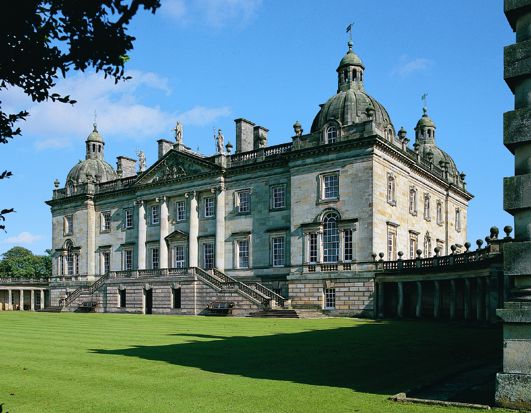
Houghton Hall
Walpole's son, the prolific letter writer Sir Horace
Walpole (1717-97), lived at Houghton Hall but was not
over enamoured with Norfolk. Here is an extract from a
letter addressed to George Montagu written on March
25th, 1761. The 'Gray' referred to in the letter is his
friend the poet Thomas Gray (1716-1771) - with whom he
was educated at Eton and at Peterhouse, Cambridge - and
who wrote the famous poem Elegy in a Country
Churchyard. The tone of the letter is somewhat
morbid.
|
|
'....Here I am at Houghton! and alone! in this spot where
I have not been in sixteen years! Think what a crowd of
reflections! - no Gray, and forty churchyards, could not
furbish so many: nay, I know one must feel them with
greater indifference than I possess, to have patience to
put them into verse. Here I am, probably for the last
time in my life, though not for the last time - every
clock that strikes tells me I am an hour nearer to
yonder church - that church, into which I have not had
courage to enter, where lies that Mother on whom I
doted, and who doted on me!' |
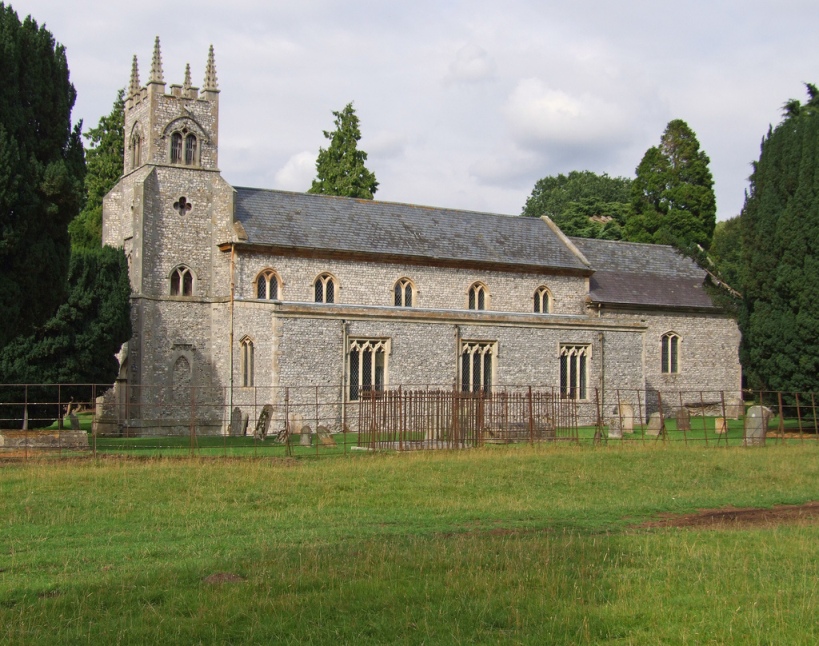
Both Sir Robert and Horace Walpole are buried in the
church of St. Martin's which lies within the grounds of
the hall; there are no memorials to them.
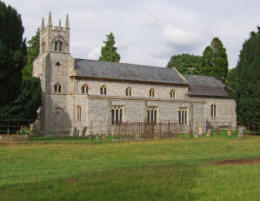
St Martin's Church,
Houghton Hall © Jim Rowe |
Horace Walpole's literary reputation rests largely
on his witty and charming letters - however he was also
the author of a pioneering Gothic novel entitled The
Castle of Otranto (1764). It was originally
published under a pseudonym and claimed to be a
translation from an Italian source. It proved to be
hugely popular with the Georgian public and inspired
many subsequent Gothic writers including Edgar Allan Poe
and Bram Stoker.
Houghton is another example of a Norfolk
deserted village and
was moved when the hall was originally being
constructed. The new village - begun in 1729 and consisting of ten pairs of cottages - was arranged along
opposite sides of a new street.Some commentators have
suggested that it was the 'emparking' here at Houghton
which inspired Oliver Goldsmith's famous long poem
The Deserted Village. However, Alan Davison - an
expert in abandoned communities - claims that the poet's
'Sweet Auburn' was actually based on Nuneham Courtney in
Oxfordshire. |
|
|
|
|

 Supported
by Norfolk Tourism
Supported
by Norfolk Tourism