|
|
|
|
Letheringsett
Letheringsett lies in the Glaven Valley just to the
east of Holt. The village
contains the last working water mill in Norfolk.
After a visit to
the county and Letheringsett Hall in 1955, the poet John Betjeman was inspired to write his poem
Lord Cozens Hardy.
The Cozens Hardy
mausoleum mentioned in the poem was fictional, but there
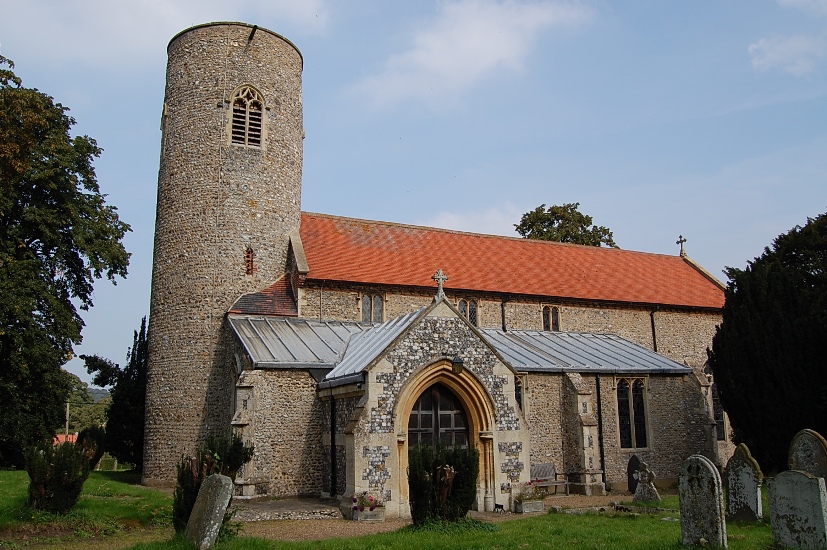
are a number of memorials to the family inside St
Andrew's church.
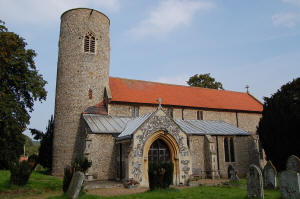
St Andrew's Church
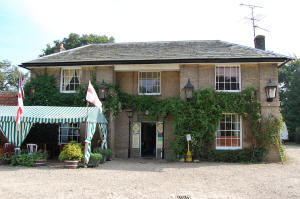
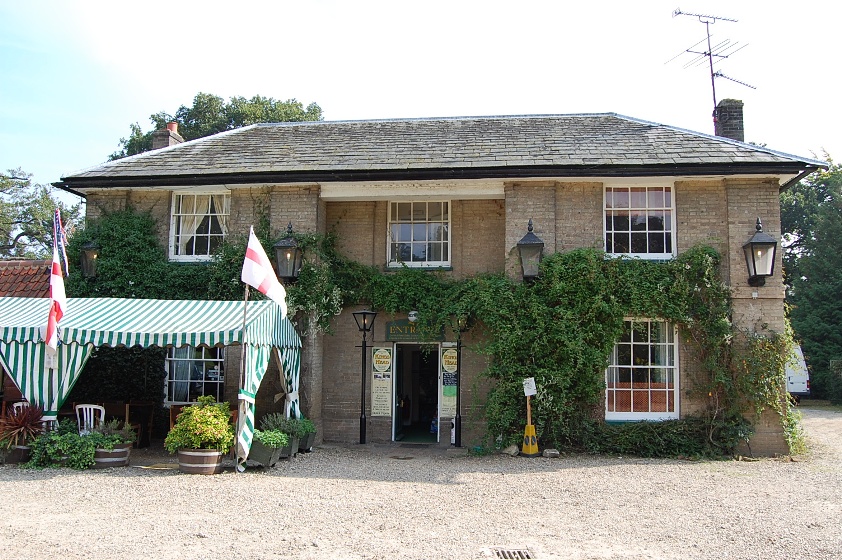
King's Head Pub
Here is the last verse of the poem which also mentions
'The King's Head' pub:
|
But when, Lord Cozens Hardy,
November stars are bright,
And the King's Head Inn at Letheringsett
Is shutting for the night,
The villagers have told me
That they do not like to pass
Near your curious mausoleum
Moon-shadowed on the grass
For fear of seeing walking
In the season of All Souls
That first Lord Cozens Hardy,
The Master of the Rolls.Read
complete poem |
Betjeman had been staying with Roy and Wilhelmine Harrod
at the time - who he knew from his days at Oxford. In
fact, he first met Billa (as she was known) in 1933 through
her friend Penelope Chetwode - who later became
Betjeman's wife. Betjeman asked Billa to marry
him when he was already engaged to Penelope. However,
this was just Betjeman's way of showing his admiration
for her and fortunately nobody took offence.
Billa Harrod published the Shell Guide to Norfolk in 1958
which was co-written with Charles Linnell who was the rector
of Letheringsett. (John Betjeman and John Piper were the
editors of the series.) As a result of her research she
discovered that many of the county's churches were in a
bad state of repair and, supported by Betjeman, she set
about saving them. She became the founding chairman of
the Norfolk Society Committee for Country Churches which
later became the Norfolk Churches Trust. In 1970 she was also instrumental in
saving 32 medieval churches in Norwich which were facing
demolition.When her husband Roy retired in 1963 the couple moved
to The Old Rectory on the outskirts of Holt. She
continued to be active in preservation and persuaded
Prince Charles to become patron of the Norfolk Churches
Trust in 1989.
Billa also acted as an adviser to Joseph Losey when
he was filming The
Go-Between in the county. Lady Harrod died in
2005 and is buried, with her husband, in the churchyard
of St Mary Magdalen, Warham.
Letheringsett is also famous for its blacksmith -
Johnson Jex - who was a self-taught scientist and left
behind a rather splendid epitaph.
|
|
This stone is erected
To mark the burial place of
JOHNSON JEX
Who died January 5th 1852 aged 73 years
Born in obscurity
He passed his days at Letheringsett as
A village blacksmith.
By the force of an original and inventive genius
Combined with indomitable perseverance
He mastered some of the greatest difficulties of science
Advancing from the forge to the crucible
And from the horse-shoe to the chronometer:
Acquiring by mental labour and philosophic research
A vast and varied amount of
Mechanical skill and general knowledge.
He was a man of scrupulous integrity and moral worth:
But regardless of wealth
And sensible to the voice of fame
He lived and died a scientific anchorite
___
There is a spirit in man: and the
inspiration of
The Almighty giveth him understanding. |
|
The letteing on Jex's grave has now all but worn away -
but fortunately there is a full printed version inside
the church next to his death mask. The epitaph also
features in A History of
Letheringsett in the County of Norfolk - which was
written by a member of the Cozens Hardy family.
|
|
More photographs of Letheringsett |
|
|
|

 Supported
by Norfolk Tourism
Supported
by Norfolk Tourism