Cley-next-the-Sea
Cley lies on the North Norfolk Coast
between Blakeney and
Salthouse. In the 13th century Cley was ranked as
England's 4th most important port and shipped large
quantities of wool to the Low Countries. However, during the 17th
century the River Glaven started to silt up and access
for shipping from the North Sea soon became impossible.
Today the village is protected by a shingle embankment
and is a popular tourist destination.
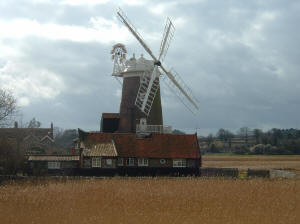
Cley Windmill
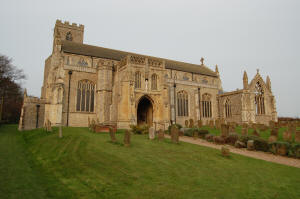
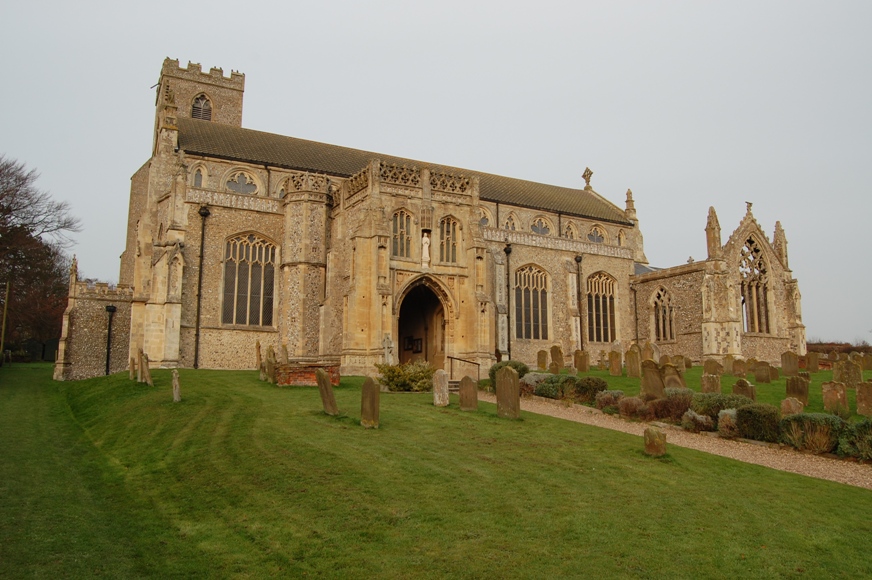
St. Margaret's Church
St Margaret's Church at Cley - which is a magnificent
building commanding a view of the Glaven valley - may
have provided the inspiration for the church in Jack
Higgins' The Eagle Has Landed.
In the book, the
author is searching for the grave of a 17th century sea
captain called Charles Gascoigne in the fictional churchyard of
St Mary and All Saints, Studley
Constable. It is not possible to say exactly which North Norfolk
village Studley Constable is based on but Cley,
Salthouse and Blakeney are all strong contenders.
Higgins describes it as follows:
|
|
'Everything about Studley Constable was intriguing. It
was one of those places that seem to turn up in North
Norfolk and nowhere else. The kind of village that you
find by accident one day and can never find again, so
that you begin to question whether it ever existed in
the first place.' |
Before arriving at Studley Constable the narrator had
already visited Cley churchyard to see the (real) grave
of James Greeve 'was the assistant to Sir Cloudesly
Shovel in ye burning ye Shippe in ye port of Tripoly in
Barbery Jan. 14th 1676'. His table tomb lies just
outside of the south transept.In the book, the
narrator continues his search of the graveyard and
eventually finds the flat tombstone of a local
wool merchant (Jeremiah Fuller) and notices that there
is another slab beneath it. Thinking that this
might be the grave of Charles Gascoigne he moves it to
investigate.
|
|
'The slab slid to one side, tilting on the slope of the
mound and all was revealed. I suppose it was one of the
most astonishing moments of my life. It was a simple
stone, with a German cross on the head - what most
people would describe as an iron cross. The inscription
beneath it was in German. It read Hier ruhen
Oberstleutnant Kurt Steiner und 13 Deutsche Fallschirmjäger
gefallen am 6 November, 1943.' |
This discovery sets off the plot of the novel which
centres upon an attempt by German paratroopers during
WW2 to kidnap the British Prime Minister Winston
Churchill. The idea for the novel may well have
originated from the fact that Winston Churchill used to
stay at the Sea Marge Hotel in
Overstrand.
|
Cley was also the place where the poet Rupert Brooke was
staying when Britain's entry into the First World War
was anounced. At the time, he was the guest of Frances
and Francis Cornford. Frances, who was the granddaughter
of Charles Darwin, was also a talented poet (based in
Cambridge) and she and her husband were frequent
visitors to the Norfolk coast. They would later purchase
the windmill at Ringstead.
Frances wrote a wonderful short poem about Brooke -
prior to his war posting:
|
A young Apollo, golden-haired,
Stands dreaming on the
verge of strife,
Magnificently unprepared
For the
long littleness of life. |
Unfortunately for Brooke, he never experienced the
'long littleness of life'.
My own poem Ornithologist is set on the
marshes at Cley - close to where the new Norfolk
Wildlife Trust visitor's centre is
located.
|
|
Ornithologist Over the roof of the hide the seed plumes
dance.
The hinged flap is up and he focuses
On the pool under the reed expanse.
Waders duck and scurry leaving prints
On the shining mud. His mind turns to the time
When leaning here he pointed out the red shank
Or the speck of the warbler, and felt
fortunate.
Even the cold touch of her ring coming back
From the storm beach under the swooping terns
Could not break that. Now the sea has
reshaped
The beach - taken the stones lower
And the hide, empty of her scent, echoes
With the perfect logic of her situation.
"I understand, believe me, I understand."
He shifts the binoculars to his other hand. |
|
Links:
More photographs of Cley
|


 Supported
by Norfolk Tourism
Supported
by Norfolk Tourism