Dereham
The large market town of East Dereham (or Dereham as it is more commonly
known) lies at the exact centre of Norfolk: 15 miles east
of Norwich and just off the busy
A47. It is particularly important for its connections
with the troubled poet William Cowper and the novelist/travel
writer George Borrow. It was also the birthplace of the
science fiction writer Brian Aldiss.
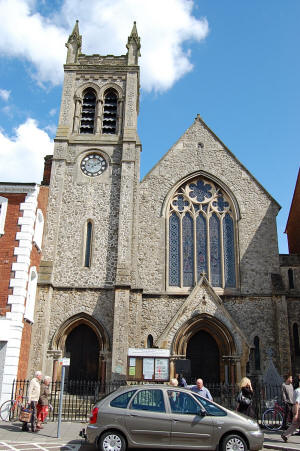
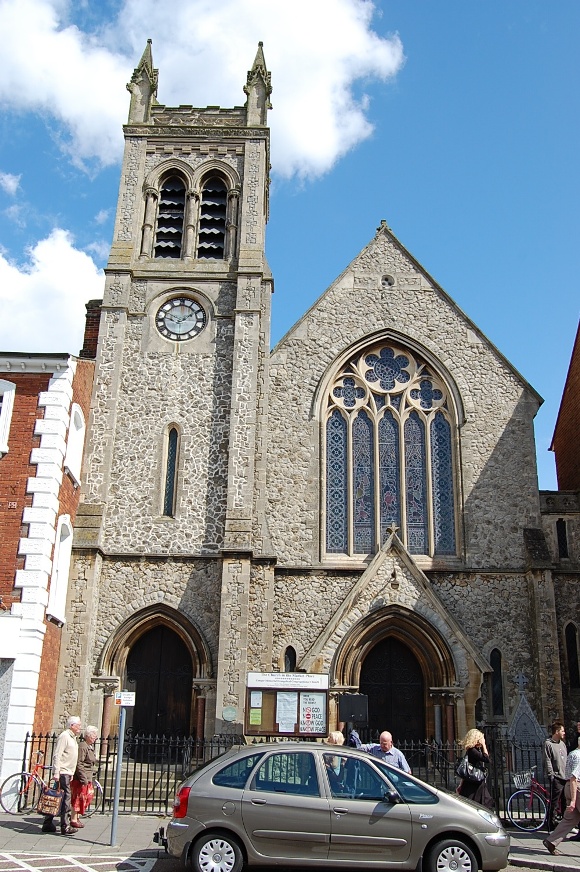
Cowper Memorial Congregational Church
|
|
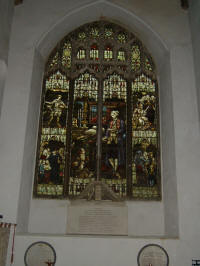
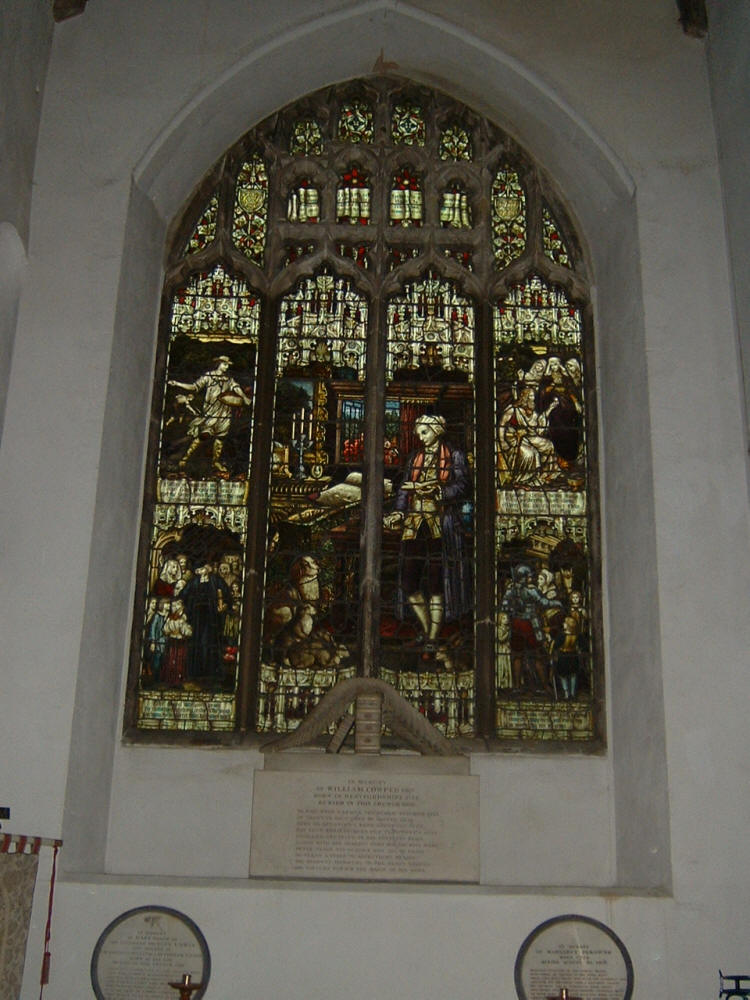
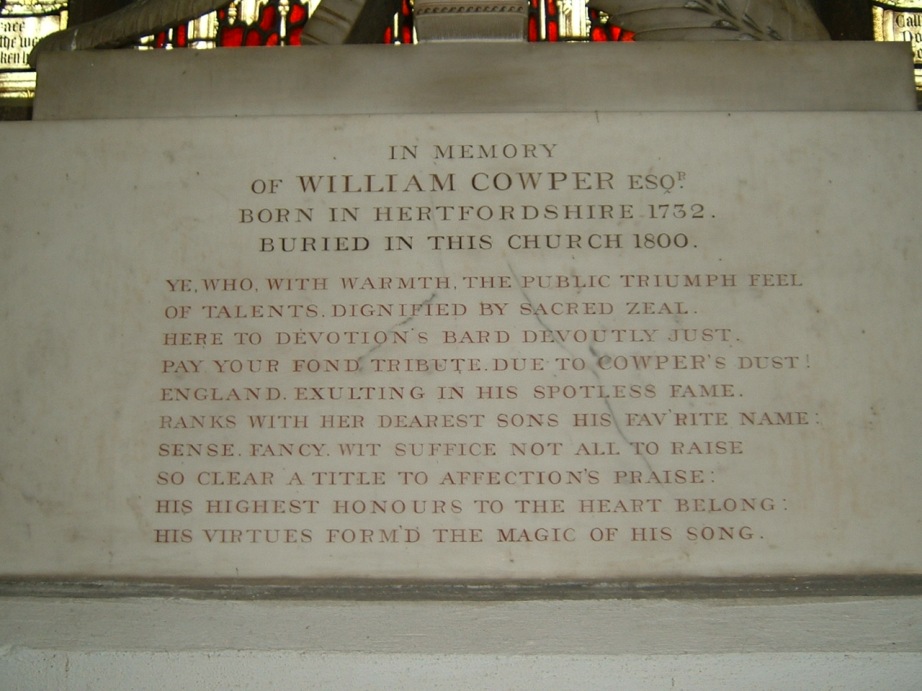
William Cowper (1731-1800) The poet William Cowper is buried inside St.
Nicholas' Church where, in the St. Thomas of Canterbury
chapel, there is a commemorative stained
glass window. It was installed in 1905 and depicts the
poet in a long purple dressing gown standing next to a
sofa. At his feet are his pet hares that he used to keep
when he lived at Olney in Buckinghamshire. The window
also contains a picture of his mother who died when
Cowper was a child.

William Cowper Cowper moved to Norfolk in
1795 with his companion Mary Unwin. At first they stayed
at North Tuddenham rectory and this enabled Cowper to
visit his cousin Anne Bodham at nearby
Mattishall. The couple then
moved to Mundesley - hoping
that the sea air would be beneficial - but unfortunately
it enflamed Cowper's eyes. From here they moved to
Dunham Lodge
- but Cowper found this dreary and rambling so, finally,
they settled in Dereham. On 17th December 1796 Mary died
leaving Cowper grief stricken. (She is also buried at
St. Nicholas' Church.)
Cowper moved one final time to another house in the
Market Place. This has now been
demolished and replaced by the Cowper Memorial
Congregational Church. By
this stage in his life he was suffering from chronic depression
verging on insanity. A memorial stone outside the church
bears lines from The Task: 'I was a stricken
deer, that left the herd/ Long since; with many an arrow
deep infixt/ My panting side was charg'd, when I
withdrew/ To seek a tranquil death in distant shades.' His harrowing poem
The Castaway
was written during his last years in Norfolk. In it
he likens himself to a sailor who is cast overboard in a
storm and is facing death by drowning. The poem may
have been inspired by his visits to
Mundesley where he
used to sail down the coast to Happisburgh. Happisburgh
churchyard is full of graves of shipwrecked
sailors. The final
verse of the poem sounds a note of terrible despair:
|
No voice divine the storm allay'd,
No light propitious shone;
When snatch'd from all effectual aid,
We perish'd each alone:
But I beneath a rougher sea,
And whelm'd in deeper gulps than he.
Read complete poem |
However, his work was varied and also contained a number of
satires such as The Sofa and humorous poems such
as John Gilpin.
Cowper Commemorative Window
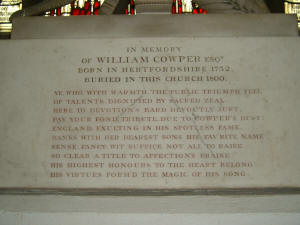
Tomb of
William Cowper |
|
George Borrow
(1803-81) In the opening lines of
Lavengro
George Borrow describes how he was born in Dereham:
|
|
'On an evening of July, in the year 18-, at East D - -,
a beautiful little town in a certain district of East
Anglia, I first saw the light.' |
However, many people assume that he was actually born at
Dumpling Green - a
hamlet just south of Dereham - although this may have
been due to an error perpetrated by his first biographer
Dr William Ireland Knapp. Borrow's mother Ann Perferment
was certainly from Dumpling Green but it is thought that
by the time of her son's birth in 1803 she was living in
rented accommodation in what is now Dereham High Street.
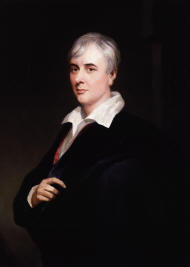
George Borrow by Henry
Wyndham Phillips
In any case, this confusion serves to highlight one of
the characteristic problems with Borrow's work - namely
the blurred line between fact and fiction. In fact, Augustus
Jessop once said of him: 'Scrupulous veracity was
hardly a characteristic of the late George Borrow. A man
of great memory, he was also a man of fertile
imagination.'
The house at Dumpling Green is quite hard to find. It lies at
the end of a long unmade up road (opposite a thatched
cottage with grass growing on the roof). When the track
splits in two, you need take the left hand fork. There
is a plaque above the door commemorating the link with
Borrow.
|
|
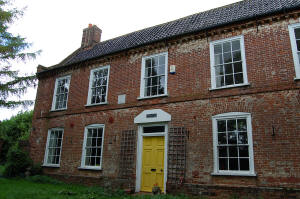
George Borrow's Birthplace?
|
In Chapter 3 of Lavengro there is
a charming description of Dereham:
|
|
'I love to think on
thee pretty, quiet D--, thou pattern of an English
country town, with thy clean narrow streets branching
out from thy modest market-place, with thine old
fashioned houses, with here and there a roof of
venerable thatch'. |
There then follows a fascinating
section in which he pays homage to William Cowper - who
lived and died in the town. Although not explicitly
mentioned - it is obvious from the description that he
is talking about the famously troubled poet:
|
|
'Pretty,
quiet D- -, with thy venerable church, in which moulder
the mortal remains of England's sweetest and most pious
bard. Yes, pretty D- -, I could always love thee, were
it but for the sake of him who sleeps beneath the marble
slab in yonder quiet chancel. It was within thee that
the long-oppressed bosom heaved its last sigh, and the
crushed and gentle spirit escaped from a world in which
it had known nought but sorrow.' |
Borrow, who had a
manic depressive character himself, would undoubtedly have felt
great empathy with Cowper's debilitating fits of
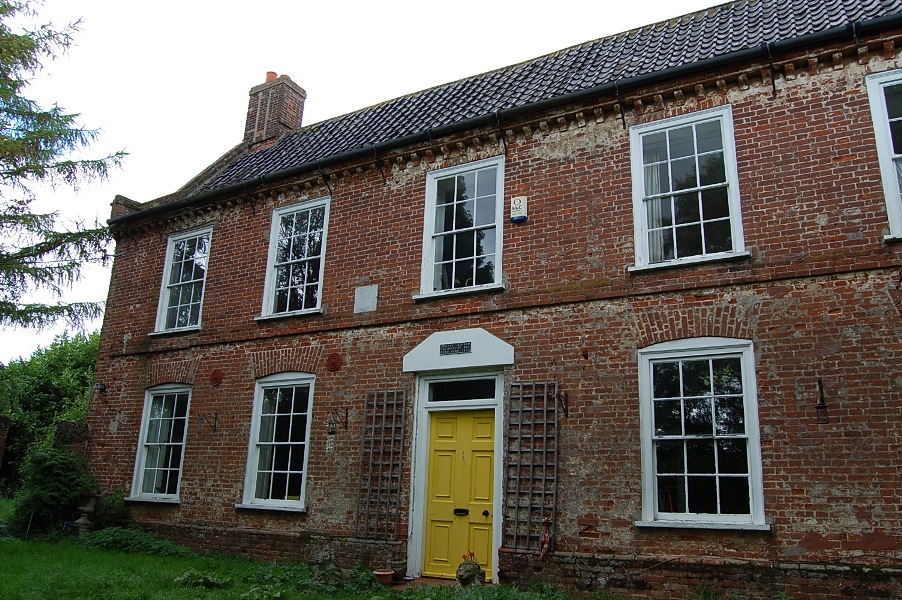
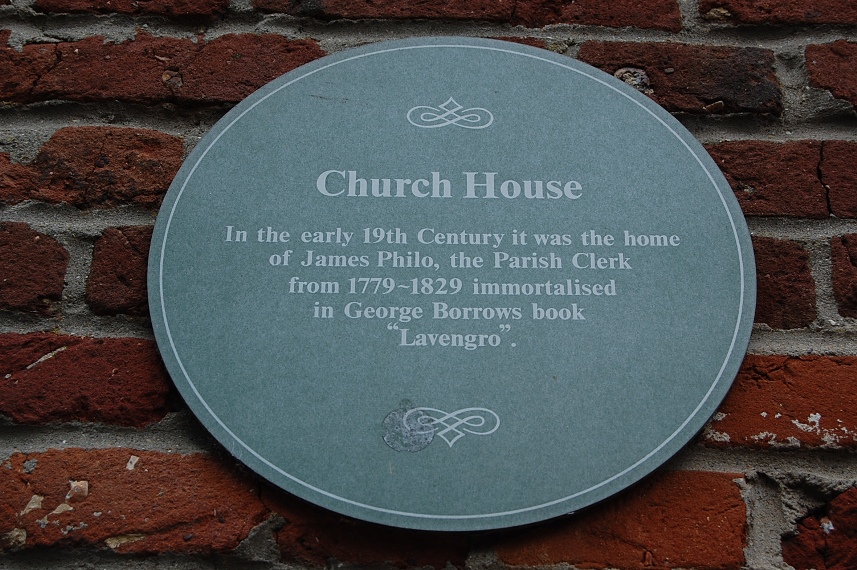
depression.On the wall of Church House,
there is a plaque commemorating the fact that Borrow
featured James Philo, the Parish Clerk of Dereham from
1779-1829, in Lavengro.
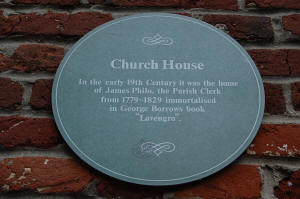
Plague on Church House
See also
Norwich and Great
Yarmouth
|
|
Benjamin Armstrong (1817-1890) Armstrong was
the vicar at East Dereham from 1850 to 1888 and, during
these years, he kept a diary of his daily life. He was
educated at Cambridge and was the incumbent of Little
Stanmore in Middlesex before moving to Norfolk.
His diaries provide a fascinating insight into the
parish life of Dereham during the second half of the
19th Century. Here are a couple of extracts:
|
|
Jan 1st, 1854 - Drove to take service at Hoe in a
sleigh, the snow being too deep for wheels. Had some
difficulty in getting through a drift where the horse
was above his knees in snow. There were 19 communicants,
and I can hardly tell how they got through the snow to
church. April 17th, 1859 - Buried Benjamin Tolladay at
Hoe. He was nearly 100 years old - one of those
righteous peasant patriarchs. With all our education and
advancement, will the next generation to them be as good
as they? |
The diaries were published in 1949 by his grandson Rev
Herbert B.J. Armstrong of King's Lynn. Although not as
well know as Rev Woodforde's diaries they are nevertheless an important piece
of Norfolk's social history.
Benjamin Armstrong is buried in the graveyard of St.
Nicholas' Church.
|
Sir John Fenn (1739-1794)
The antiquarian Sir John Fenn also lived in Dereham
and was the first editor of The Paston
Letters - publishing the original collection in 1787.
His house, which is now the Hill House Hotel, stands at
the north-east end of the town.
|
|
Hyam Plutzik (1911-62) During WW2 the American
poet Hyam Plutzik was stationed at nearby
Shipdham Airfield - where he
worked as the Information and Education Officer for the
44th Bombardment Group of the USAAF. While based at
Shipdham was inspired to write two poems about the
airfield - namely
Bomber Base and
On the
Airfield at Shipdham. However, in his first
collection
Aspects of Proteus - there is also an intriguing
poem about Dereham. It is likely that the characters in
the poem are fictional.
|
|
Mr Ingleshot of
Dereham
They say there
are words to everywhere,
But I know somewhere where no word goes.
The thoughts are
swifter than Arab horses
Or slow as the oxen and their wain.
They have beaten
a pathway deeper down
Than the track of the Celt beyond the farms.
Love and death
are the wayside flowers—
The old rose and the loving poppy.
Them I have
trampled over the bank
To the thicket between and what grows there.
Here from my eyes
let the fire speak....
Though they laugh
at me and Peg of the Brook,
Glum John and his little brother.
(Copyright by the estate of Hyam
Plutzik. All rights reserved.) |
Links:
More Dereham photographs
|

 Supported
by Norfolk Tourism
Supported
by Norfolk Tourism