Eccles-on-Sea
What remains of Eccles lies on the Norfolk
coast between Sea Palling and
Happisburgh.
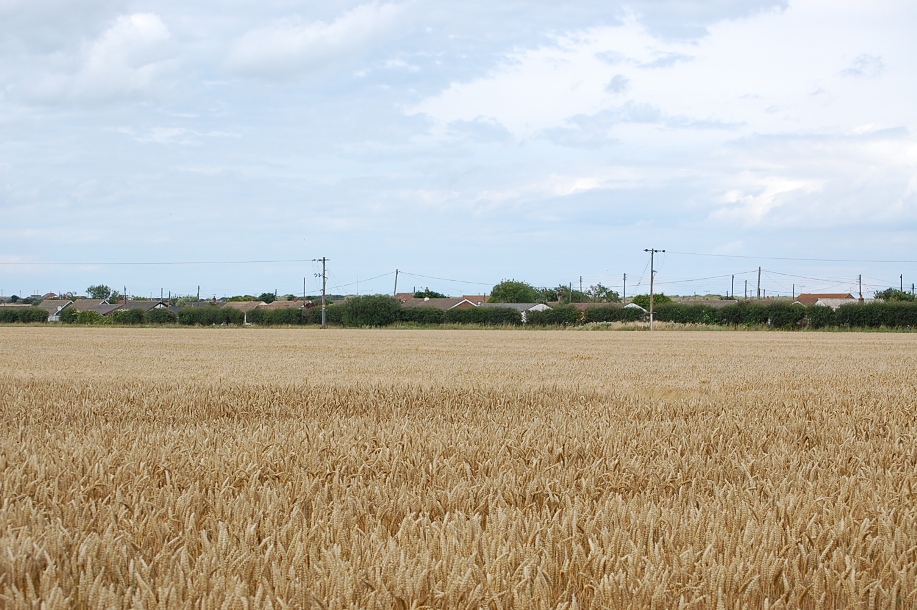
Today this is only the Bush Estate - a collection of
pre-war bungalows and caravans tucked in behind the sand dunes.
However, Eccles was once a complete village - although
it has always been under the threat from the sea. In
1570 and 1571 the Norfolk coast was hit by four
ferocious storms which seriously undermined the village.
It was then hit by another damaging storm in 1604 which
lead it to petition, in 1605, for a reduction in its taxes when only 14
houses and 300 acres of land remained.
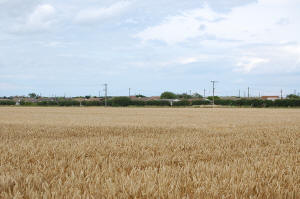
The Bush Estate
On January 25th 1895 St. Mary's church at Eccles
finally fell into the sea and the church tower was a
familiar sight protruding from the beach.
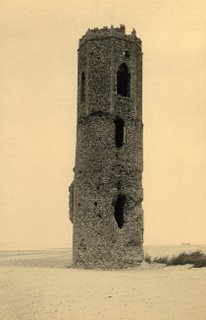
Eccles Church Tower
In Norfolk Life, Lilias Rider Haggard
(1892-1968) recalls visiting Eccles when she was a child
and witnessing the gruesome sight of skeletons exposed
in the sea-washed graveyard.
|
| 'One September day
years ago, when the tower of Eccles Church still stood
on the dunes, there came a north-easterly gale and a
'scour' which swept the sand from the old graveyard,
leaving the long outlines of the graves washed clean by
the sea. In one lay an almost perfect skeleton embedded
in the clay, the hollow-eyed skull gazing up at the
limitless sweep of the sky.' |
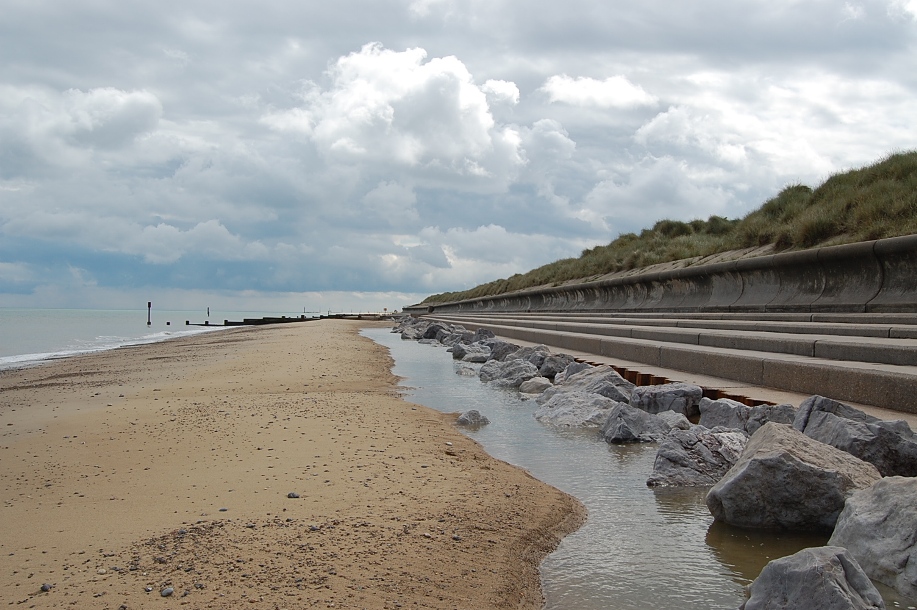
As late as the 1980s, the foundations of the church used
to appear at low tide but since the construction of an
off shore rock reef by the Environment Agency the level
of sand on the beach has been too high to see anything.
However, pieces of flint masonry from the tower can
still be found along this section of coast.
The name 'Eccles' is derived from the Latin word for 'Church'
(Ecclesia) and this connection helped Anthony Thwaite
(1930-2021)
(see Low Tharston) - a
Norfolk-based poet - to write the following poem about
the village:
|
Cliffs sifting
down, stiff grassblades bent,
Subdued, and shouldering off thick sand,
Boulders - compacted grout and flint -
Jut from a stranded beach, a land
Adhering lightly to the sea.
Tide-drenched, withdrawn, and drowned again,
Capsized, these buttresses still strain
Towards perpendicularity.The place-name mimes the
fallen church,
Abbreviated, shrunk to this
Truncated word, echo of speech,
A Latin ghost's thin obsequies
Carried by wind, answered by sea -
Ecclesia: the syllables
Curtailed, half heard, like tongueless bells
From empty steeples endlessly. |
This stretch of coast is still notorious for its high
rate of erosion and nearby Happisburgh is currently
under great threat. The beautiful 12th century church of
St Mary's may one day suffer the same fate as its name
sake at
Eccles.
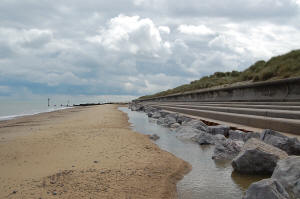
Eccles Beach today
Fishermen used to say that you could still hear the
bell of Eccles church ringing under the waves.
Today Eccles-on-Sea is often referred to as
'Eccles-in-the-Sea'.
|
Links:
More photographs of Eccles and the Bush Estate
|
|

 Supported
by Norfolk Tourism
Supported
by Norfolk Tourism