|
|
|
|
Stiffkey
Stiffkey lies on the North Norfolk coast between
Wells and Morston:
its name derives from 'tree-stump island'. It is a
beautiful village consisting largely of flint and brick cottages
- built on the banks of the charming River Stiffkey. The
main street of the village is narrow and winding and is
bordered on both sides by high walls - making it a
dangerous place for pedestrians - especially in the busy
summer months. High above the village sit Stiffkey Old
Hall and the church of St. John the Baptist.
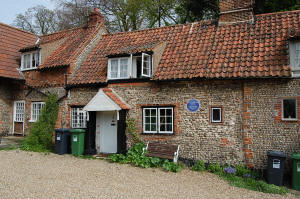
Henry
Williamson's Cottage
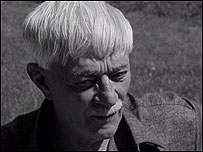
Henry
Williamson
In 1937 Henry Williamson - the author of Tarka the Otter -
purchased Old Hall Farm in Stiffkey for £2250. He
was anxious to contribute to Sir Oswald
Mosley's new vision of Britain - but he
had no previous experience of farming
and after eight years he abandoned the
farm and returned to his beloved Devon.
He recorded his experiences in The
Story of a Norfolk Farm (1941). The
book contains some memorable
descriptions of the north Norfolk coast:
|
|
'The sea was half a mile from the
village, and the field ended in a
plantation or land-fringe of stunted
trees, and then steeply down to a pebbly
shore and a creek where a fisherman's
boat was moored. We sat down on the
grass, gazing out over the marshes, one
vast gut-channered prairie of pale blue
sea-lavender. Afar was the sea merging
in summer mist and the palest azure sky.
There was no sound: the air was still:
not a bird stirring. This was the sun I
remembered from boyhood days, the
ancient harvest sunshine of that
perished time when the earth was
fresh...' |
|
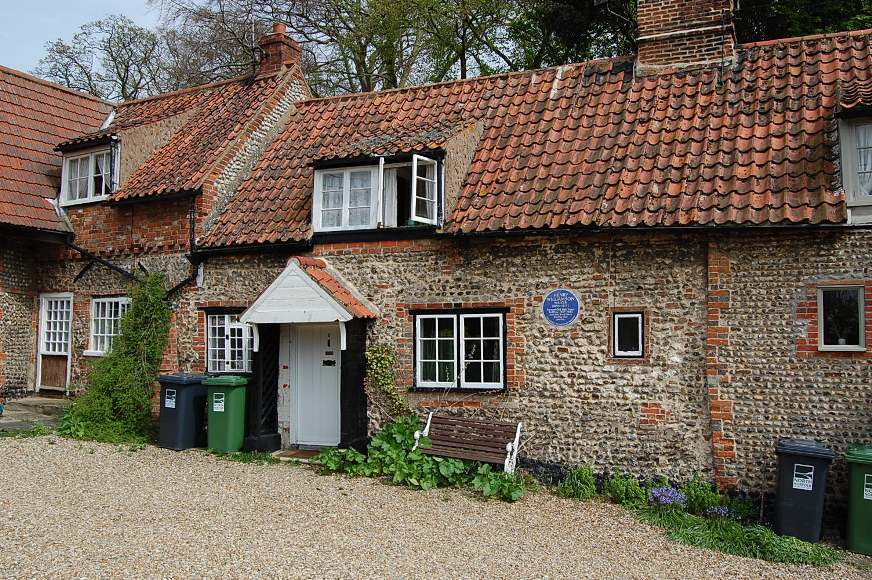
For some of the time, Williamson
lived in a small cottage off the village
street - known as Walnut Tree Cottage. (It lies next to the antique
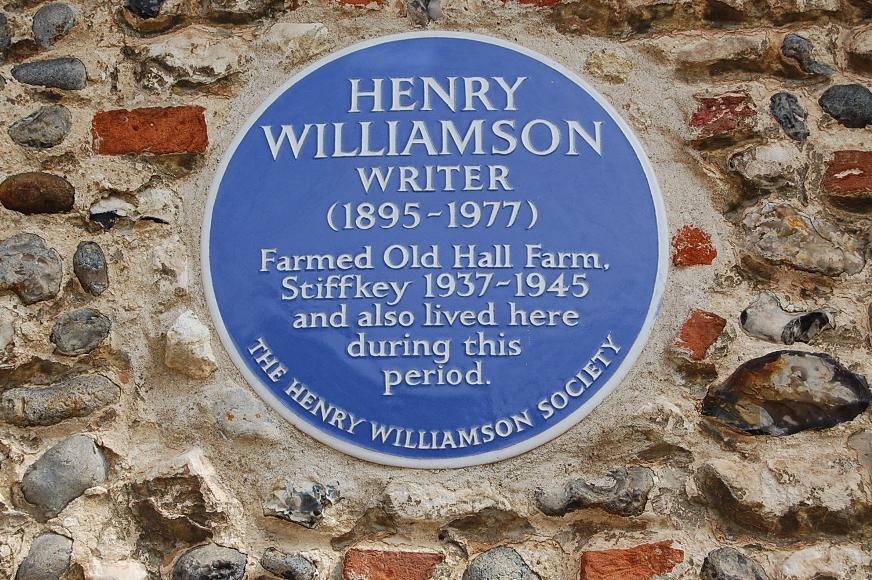
shop.) A commemorative plaque has now
been erected by the Henry Williamson
Society. He also lived in another
cottage in the village called River View
Cottage (previously Meadow Lea Cottage)
which served as his studio/library. Williamson collaborated
with Lilias Rider
Haggard (see Ditchingham) on Norfolk Life (1943)
- a compendium of Norfolk essays and
vinettes.
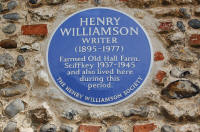
Williamson Plaque
Alan Savory - the Norfolk wildfowler - wrote vividly
about duck shooting on the North Norfolk marshes
including Stiffkey. The Stiffkey marshes are famous
for the 'stewkey blues' - a type of cockle
with a distinctive blue colour. Here is an extract from Savory's Norfolk Fowler (1953):
|
|
'There is a place far out on the sands
somewhere between High Sand Creek and
Stone Mell Creek that is called
Blacknock. It is a patch of mud covered
with zos grass and full of blue shelled
cockles known as "Stewkey Blues". It is
a famous place for widgeon, but very
dangerous to get on to and off, if one
is not too certain of the way on a dark
night. The women cockle gatherers from
Stiffkey (or Stewkey, as it is sometimes
called) who have double the strength of
a normal man, go right out there between
the tides and get a peck of these
cockles and carry them back to the
village, miles across the sea and
saltings.' |
Stiffkey is also famous for the Revd
Harold Davidson who was rector in the
village during the 1920s and 1930s.
Davidson launched a one-man crusade to
save fallen women in London which caused
scandal and controversy and eventually
led to the loss of his living. He may
well have provided the inspiration for
Michael Palin's film The Missionary.
Bizarrely, Davidson died after he was
mauled to death by a lion in a sideshow on
Skegness seafront; however his body was brought
back to Stiffkey.
Davidson's funeral, which took
place in 1937, was witnessed by a young
Allan Smethurst - who was on holiday in
the village at the time. Smethurst would
later transform himself into the
Singing
Postman - a quirky, but authentic
Norfolk singer-songwriter.
|
Links:
More photos of Stiffkey
Henry Williamson Society
|
|
|
|

 Supported
by Norfolk Tourism
Supported
by Norfolk Tourism