|
|
|
|
Weeting
|
| Weeting lies in the
Brecklands in one of the oldest inhabited parts of
Norfolk. Within the parish are the remains of the
prehistoric flint mines known as Grime's Graves which
consist of 400 separate mine shafts on a 34 acre site
dating back 5000 years. Today the site has the
appearance of a pock-marked, lunar landscape due to the
in-filling of the mine shafts.
In his moving memoir Nature Cure - Richard
Mabey records a visit to one of the mine shafts:
|
|
'There are two bands of flint in the chalk. Half-way
down is a lode of dark, split stones a foot deep,
shining, as if they have just been splashed with water.
At the bottom is the floorstone, which held the most
prized flints. There are little chambers and galleries
branching off the main shaft, barred-off but
artificially lit. The ceilings are very low. The diggers
(were there children and women amongst them?) must have
had to lie on their backs to prise out stones.' |
This distinctive location also features in Brian
Cooper's detective novel The
Travelling Dead as the 'chipping fields' and in
Colin (Middleton) Murry's autobiography One Hand
Clapping (1975). (Murry was the son of John
Middleton Murry and grew up at the rectory at
Larling. He also wrote under
the pen-name Richard Cowper.)
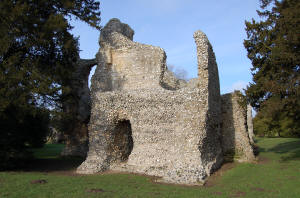
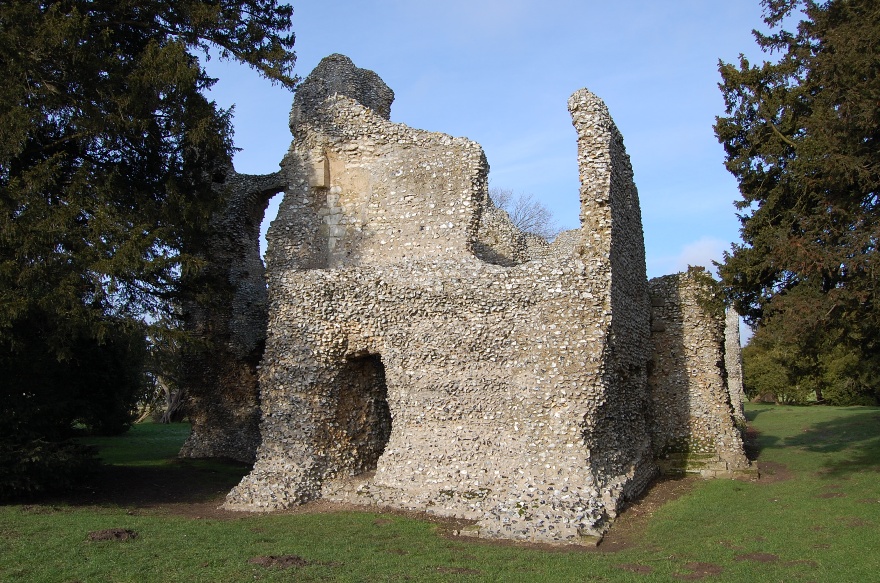
Remains of Weeting
Castle
Weeting has a
couple of other important literary connections. Weeting Castle
- which is the remains of a medieval moated house - appears in
Hereward the Wake
by Charles Kingsley (1819-1875). In the story
William the Conqueror was based at Weeting hoping to
capture Hereward's stronghold on the Isle of Ely.
However, Hereward disguises himself as a potter and
infiltrates William's court and discovers vital
information before escaping and returning to Ely.
Charles Kingsley
was a history don at Cambridge University and
therefore was familiar with the fens and the
surrounding areas. However, there is no historical
evidence to suggest that the events portrayed in his
novel actually occurred.

Thomas Shadwell
The poet and dramatist Thomas Shadwell (1742-1792)
may have
been born at Weeting - either at Stanton Hall or at
Bromehill Farm. In his day he was well known for his
witty plays but, today, he is best remembered for his
war of words with the poet John Dryden. Dryden attacked
him in both
Mac Flecknoe and Absalom and
Architophel.
Shadwell wrote some
14 comedy dramas and a number of operas including
one based on Shakespeare's The Tempest.
He succeeded Dryden as poet laureate in 1689.
Just to the east of
Thetford lies the village
of Shadwell - which may lend credence to his Norfolk
origins.
|
|
More photographs of Weeting |
|
|
|


 Supported
by Norfolk Tourism
Supported
by Norfolk Tourism