Winterton-on-Sea
Winterton lies on the Norfolk coast between Hemsby
and Horsey. The village is
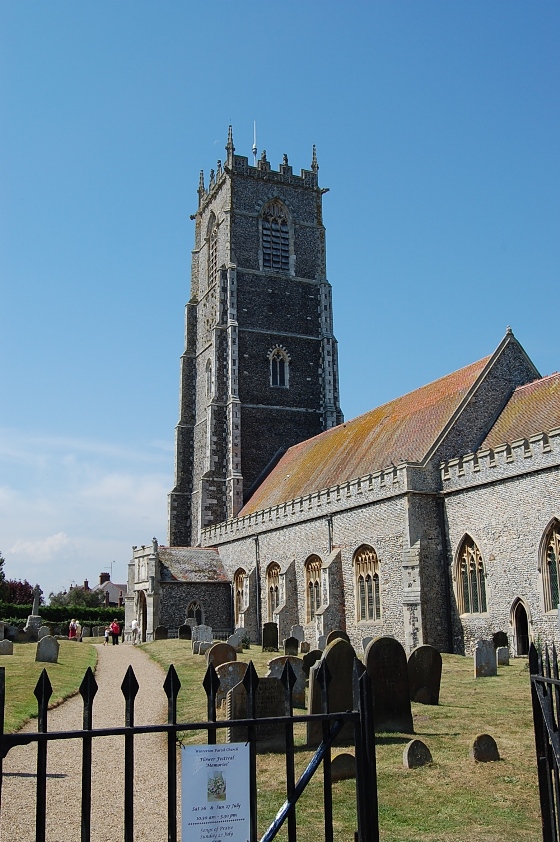
dominated by the tower of Holy Trinity Church which
rises to the height of 132 feet. Winterton has a long
history as a sea-faring and fishing village and also
lies on a notoriously dangerous stretch of coast. The
churchyard of Holy Trinity is littered with the graves
of sailors who died at sea - and inside there is a
Fisherman's Corner established by the Rev. Clarence
Porter who, himself, drowned while attempting to save a
choir boy.
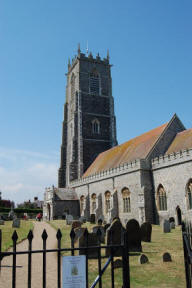
Holy Trinity Church, Winterton
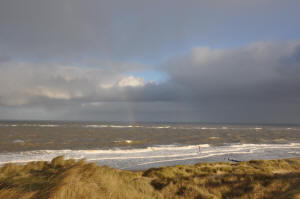
Winterton Ness
Daniel Defoe (1660-1731)
In his A Tour Through the Whole Island of Great
Britain (1724-6) Daniel Defoe was well aware of
Winterton's reputation and wrote:
|
|
'The danger to ships going northwards is, if after
passing by Winterton they are taken short with a
north-east wind, and cannot put back into the Roads,
which very often happens, then they are driven upon the
same coast, and embayed just at the latter. The dangers
is this place being thus considered, 'tis no wonder,
that upon the shore beyond Yarmouth, there is no less
than four light-houses kept flaming every single
night....' |
|
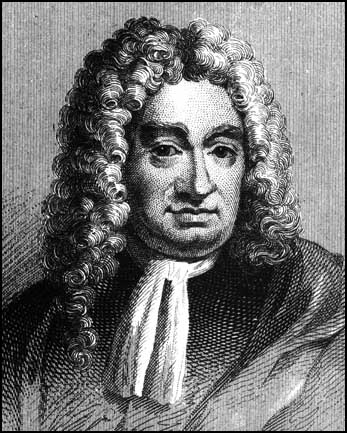
Daniel Defoe
He then goes on to document a terrible series of
shipwrecks off Winterton Ness which occurred on a single
night in 1692:
|
|
About the year
1692, (I think it was that year) there was a melancholy
example of what I have said of this place; a fleet of
200 sail of light colliers (so they call the ships bound
northward empty to fetch coals from Newcastle to London)
went out of Yarmouth Roads with a fair wind, to pursue
their voyage, and were taken short with a storm of wind
at N.E, after they were past Winterton Ness, a few
leagues; some of them, whose masters were a little more
wary than the rest, or perhaps, who made a better
judgment of things, or who were not so far out as the
rest, tack'd, and put back in time, and got safe into
the roads; but the rest pushing on, in hopes to keep out
to sea, and weather it, were by the violence of the
storm driven back, when they were too far embay'd to
weather Winterton Ness, as above; and so were forc'd to
run west, every one shifting for themselves, as well as
they could; some run away for Lyn Deeps but few of them,
(the night being so dark) cou'd find their way in there;
some but very few rid it out, at a distance; the rest
being above 140 sail were all driven on shore, and
dash'd to pieces, and very few of the people on board
were sav'd:
At the very same
unhappy juncture, a fleet of loaden ships were coming
from the north, and being just crossing the same bay,
were forcibly driven into it, not able to weather the
Ness, and so were involved in the same ruin as the light
fleet was; also some coasting vessels loaden with corn
from Lyn, and Wells, and bound for Holland, were with
the same unhappy luck just come out, to begin their
voyage, and some of them lay at anchor; these also met
with the same misfortune, so that in the whole, above
200 sail of ships, and above a thousand people perished
in the disaster of that one miserable night, very few
escaping. |
It is no coincidence, then, that it is also at
Winterton that Robinson Crusoe experiences his first
shipwreck. After setting sail from Hull, Crusoe travels
down the east coast but gets into difficulty off the
Norfolk coast. Fortunately though he manages to reach the
shore in a rowing boat and make his way back to
Yarmouth on foot. Robinson Crusoe was first published in 1719
and is widely regarded as the first English novel.
|
|
'While we were in this condition, the men yet labouring
at the oar to bring the boat near the shore, we could
see (when, our boat mounting the waves, we were able to
see the shore) a great many people running along the
strand, to assist us when we should come near; but we
made slow way towards the shore; nor were we able to
reach the shore till, being past the lighthouse at
Winterton, the shore falls off to the westward, towards
Cromer, and so the land broke off a little the violence
of the wind. Here we got in, and, though not without
much difficulty, got all safe on shore, and walked
afterwards on foot to Yarmouth...' |
|
Defoe drew inspiration for the novel from the real-life
adventures of Alexander Selkirk who, in 1704, was put
ashore on the uninhabited island of Juan Fernandez in
the Pacific Ocean. Selkirk was rescued five years later
by Woodes Rogers.
Wilkie Collins (1824-1889)
While researching his novel Armadale (1866) - Collins visited Winterton and
fell in love with a local
girl called Martha Rudd - who later returned to London
with him and became his partner.
|
|
Sam Larner (1878-1965) The folk singer and
fisherman Sam Larner lived in Winterton and there is now
a blue plaque on the wall of his former cottage. Sam was
discovered in 1956 by a BBC radio producer from
Birmingham who recorded 25 of his songs. Sam learnt most
of his songs - some of which were a bit risqué
- from fishermen he worked with on the drifters. He is best known for
Now Is The Time For Fishing. Ewan MacColl also wrote
The Shoals of
Herring about Larner's life.
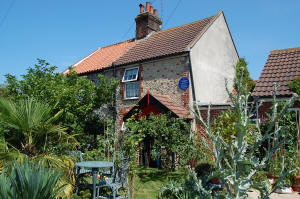
Sam Larner's Cottage
|
|
Sylvia Townsend Warner (1893-1978) The novelist Sylvia Townsend Warner visited Winterton
frequently staying at the Hill House which was once owned by
Valentine Ackland's family. The Hill House is now part
of the rather bizarre holiday centre which includes
African inspired thatched huts.
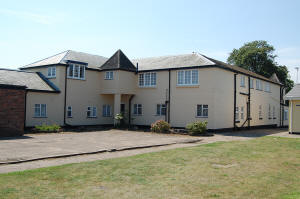
The Hill House today
Both Ackland and Townsend Warner wrote
poetry inspired by the beach and dunes at Winterton.
Here is Ackland on the subject: 'The dandling sea nursed
me, the sand was soft and gentle./ Larks sang and I was
unwatched for long hours of clear daylight.' The couple
later became gay lovers and lived for a time at both
Salthouse and
Sloley.
Edwin Brock (1927-97)
After careers in the Metropolitan Police Force and
advertising, the
poet Edwin Brock moved to Low
Tharston in Norfolk in the 1970s. In 1993 he suffered a stroke
and for several weeks lost both his memory and his
ability to speak. However, he managed to recover his
health and in the final years of his life he wrote
prolifically - frequently inspired by the
Norfolk landscape. Here is a his delightful poem entitled Winterton:
|
It is a sinking
into sand; marram grass
too sharp to lie on; eyes
stinging in the wind, and
a nerve in the cheek jumping
like an actor playing Dostoevsky.A few memories
remain:
the seal pup
dragging its wound up the beach
showing a ripped belly
and crying for help;
terns dive-bombing
the air above their nests;
the flotsam fox
bitten and chewed
scourged and scraped
but still recognisable
and always the grey North Sea
disappearing into a grey sky.
Beachcombing between the season's
limbs to discover
loneliness
or coming off the frost-crisp dunes
rejoicing in ownership.
Sixty-eight years should burst
the walls of a skull with this;
but mostly it drifts
like fine sand, or bangs
against the groynes whenever
the wind blows towards the land. |
The following anonymous rhyme presents a disparaging
view of the Winterton - and some of its neighbours:
|
Pakefield for Poverty
Lowestoft for Poor,
Gorleston for Pretty Girls
Yarmouth for Whores,
Caister for Water Dogs
California for Pluck:
Beggar old Winterton -
How Black she do look! |
Links:
More photographs of Winterton
More Edwin Brock Norfolk Photo Locations |
|




 Supported
by Norfolk Tourism
Supported
by Norfolk Tourism