Cromer
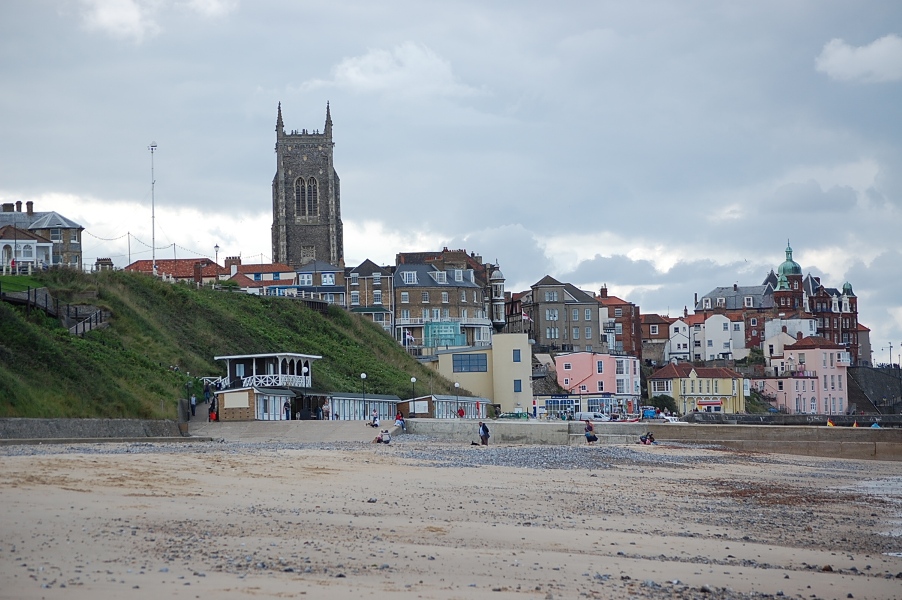
Cromer lies on the North Norfolk coast between
Sheringham and
Overstrand and has been a
popular seaside destination since the late 1700s. Today,
Cromer has an air of decayed grandeur but it is still
pulling in the visitors. Many come to walk along the
pier or to sample some of its famous crabs. The
town also
boasts the tallest church tower in Norfolk - as well as
being the home of Henry Blogg - the
coxwain of the local lifeboat who served for 37 years
and saved 518 lives.
Over the years Cromer has inspired many writers and
the town is proud of its literary heritage. Set into the
promenade are a series of stone rings featuring quotes
from Oscar Wilde, Elizabeth Gaskell and the poet A.C.
Swinburne. The typeface on these installations was
designed by Ray Carpenter.
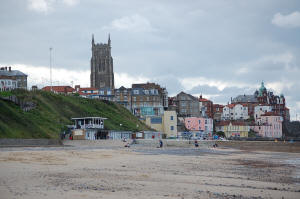
Cromer from the Beach
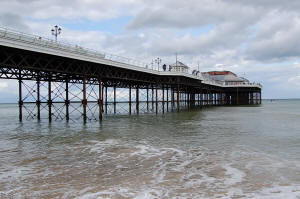
Cromer Pier
|
|
John Taylor (1580-1653) In 1622 John Taylor,
the Water Poet, was forced to land at Cromer due to bad
weather. He was undertaking a 'wagering journey' from
London to York. Unfortunately the town's folk mistook him and his crew for pirates and called the
constables. Taylor, later recorded the whole incident in
verse. In the same poem he also records how Cromer, like
most of the Norfolk coast, was (even then) suffering
from erosion:
|
'It is an ancient town that stands
Upon a lofty cliff of mouldering sands;
The sea against the cliffs doth daily beat,
And every tide into the land doth eat.'
Read complete poem |
Daniel Defoe (1660-1731)Defoe visited Cromer
on his Tour Through the Whole Island of Great Britain
but wasn't over impressed by what he found:
|
|
'Cromer is a market town close to the shore of this
dangerous coast. I know nothing it is famous for except
good lobsters.' |
|
Jane Austin (1775-1817)
In Emma - Emma's father tells her, when
discussing sea-bathing that:
|
|
'You should have gone to Cromer, my dear, if you went
any where - Perry was a week at Cromer once, and he
holds it to be the best of all the sea-bathing places.' |
Mrs Gaskell (1810-1865)
In North and South (1885) Margaret Hale
visits Cromer with her Aunt Shaw and finds the location
curative. Part of the following passage is featured in a
stone ring on the promenade - just south of the pier.
|
|
'Cromer was, in one sense of the expression, the best
for her. She needed bodily strengthening and bracing as
well as rest.... She used to sit long hours upon the
beach, gazing intently on the waves as they chafed with
perpetual motion against the pebbly shore - or she
looked out upon the more distant heave and sparkle
against the sky, and heard, without being conscious of
hearing, the eternal psalm, which went up continually.
She was soothed, without knowing how or why.' |
Edward Lear (1812-1888)Wrote a famous limerick about the town:
|
There was an old person from Cromer
Who Stood on one leg to read Homer;
When he found he grew stiff, he jumped over the cliff
Which concluded that Person from Cromer. |
Algernon Charles Swinburne (1837-1909)While
staying at the Mill House in nearby
Sidestrand - Swinburne
wrote a poem about Cromer entitled
A
Haven which had the following refrain line: 'Where the small town smiles, a warm still sea-side nest.'
|
|
Clement Scott (1841-1904) The Victorian theatre
critic did much to popularise Cromer and the surrounding
area - referring to it as
'Poppy-Land'. He visited in 1883 and then, on his return
to London, wrote a letter to the The Daily Telegraph which
spoke of 'a blue sky without a cloud across it, a sea
sparkling under a haze of heat, wild flowers in
profusion'.
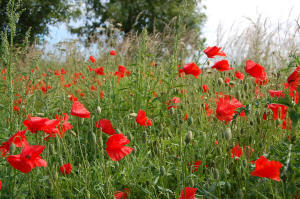
Poppy Land
His enthusiasm for the area inspired a number of
famous Victorian poets to visit - including Oscar Wilde,
A. C. Swinburne, Theodore Watts-Dunton and Alfred Tennyson. Scott
later rented the Mill House in Sidestrand.
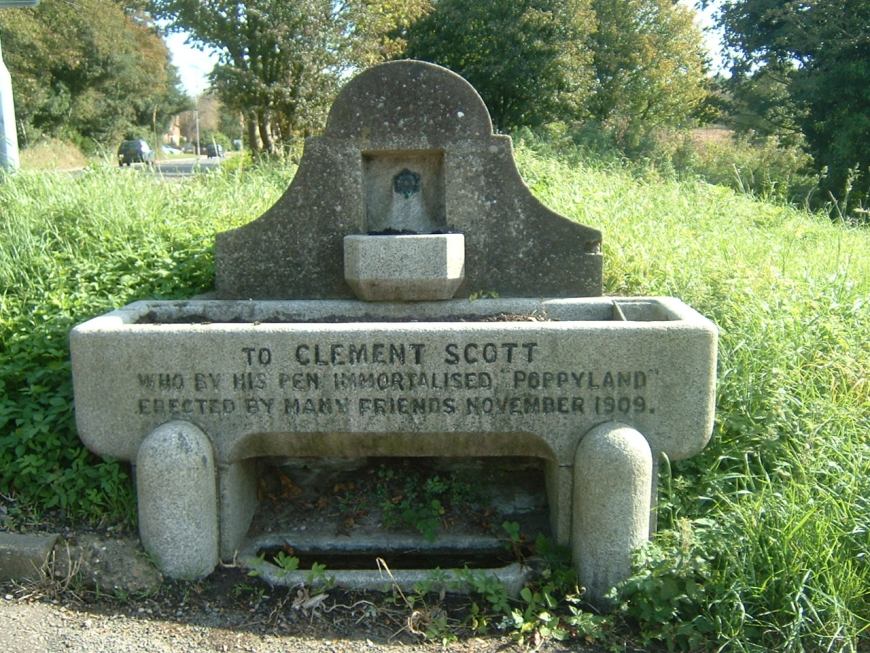
There is a memorial fountain to Scott at the
junction of Northrepps and Overstrand Road in
the town.
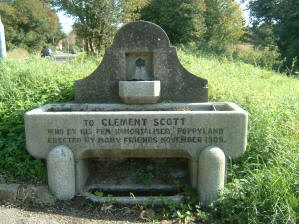
Clement Scott Fountain
It was in Scott's poem the Garden of
Sleep that the term 'Poppy-Land' first appeared. The
tower mentioned in the poem was Craske's Tower
located at nearby Sidestrand. The tower, which was a
famous Norfolk landmark for many years, finally fell
into the sea in
1917. The graveyard attached to the church
also toppled into the sea.
Norfolk has lost a number of its churches to
the sea - most famously at Eccles
- and it was not uncommon for human bones to wash up on
the beach.
|
The Garden of Sleep
On the grass of the cliff, at the edge of the steep,
God planted a garden - a garden of sleep!
'Neath the blue of sky, in the green of the corn,
It is there that the regal red poppies are born!
Brief days of desire, and long dreams of delight,
They are mine when Poppy-Land cometh in sight.
In music of distance, with eyes that are wet,
It is there I remember, and there I forget!
O! heart of my heart! where the poppies are born,
I am waiting for thee, in the hush of the corn.
Sleep! Sleep!
From the Cliff to the Deep!
Sleep, my Poppy-Land,
Sleep!
Read complete poem
|
Oscar Wilde (1854-1900)The famous, flamboyant
playwright stayed at the Hotel de Paris in 1892. He came
to Norfolk for a rest and spent time at Cromer and in a
cottage at nearby Felbrigg.
While staying at the Hotel de Paris, it is thought that
he was working on A Woman of No Importance - a
play which was first performed in 1893.
|
|
Arthur Conan Doyle (1859-1930)
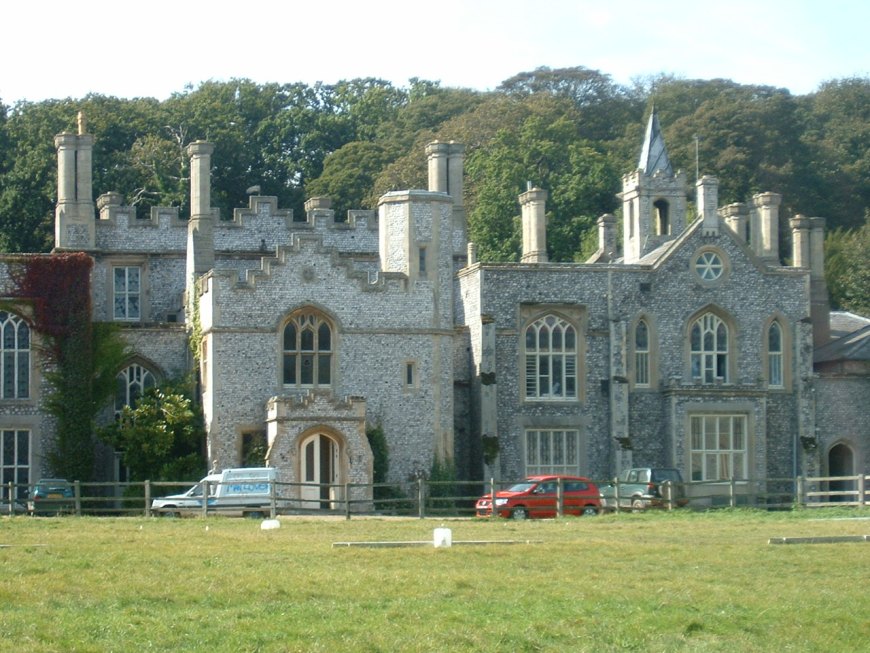
It is likely that Sir Arthur Conan Doyle used
Cromer
Hall as the inspiration for 'Baskerville Hall' in The
Hound of the Baskervilles. It is also likely that he
drew inspiration for the book from the Norfolk legend of
Black Shuck - the terrible hell-hound with the fiery eyes.
However, he eventually located the novel - to chilling
effect - on Dartmoor.
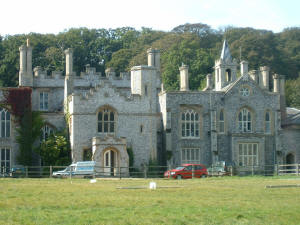
Cromer Hall
Here is Conan Doyle's haunting
description of Baskerville Hall:
|
|
'The avenue opened into a broad expanse of turf, and the
house lay before us. In the fading light I could see
that the centre was a heavy block of building from which
a porch projected. The whole front was draped in ivy,
with a patch clipped bare here and there where a window
or a coat-of-arms broke through the dark veil. From this
central block rose the twin towers, ancient, crenellated,
and pierced with many loopholes. To right and left of
the turrets were more modern wings of black granite. A
dull light shone through heavy mullioned windows, and
from the high chimneys which rose from the steep,
high-angled roof there sprang a single black column of
smoke.' |
|
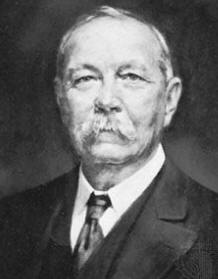
Sir Arthur Conan Doyle
|
George Barker (1913-1991)
Barker lived at
Itteringham and was a frequent visitor to the North
Norfolk coast. One of his best known poems:
On a Friend's Escape from Drowning Off the Norfolk Coast
is set on the beach at Cromer.
|
|
Keith Skipper The journalist and broadcaster
Keith Skipper lives in Cromer and for many years has
championed Norfolk and the Norfolk dialect. He has
published over 30 books celebrating the county - including
a tribute to The Singing Postman. In 1999 he helped to
set up Friends of Norfolk Dialect (F.O.N.D.) - an
organisation dedicated to preserving the vernacular. It
also fights the spread of of what he terms 'Mummerzet' -
namely the inaccurate rendering of the Norfolk accent in
film and TV. In 2007 he was awarded the MBE.

Keith at Buckingham
Palace
Stephen Fry (1957- )
While studying at the Norfolk College of Arts and
Technology (NORCAT) in King's Lynn, Stephen Fry got a
Christmas job as a waiter in the Hotel de Paris on
Cromer seafront. His hero Oscar Wilde had previously
stayed in the hotel in the nineteenth century. He
describes his time in the hotel in his autobiography
Moab Is My Washpot:
|
|
'Phil and Dale got me a job at Christmas as a waiter at
the Hotel de Paris in Cromer. In a week I earned a
hundred pounds, and by Christ I earned it. I think I
must have walked two hundred miles between kitchen and
restaurant, silver-serving from breakfast to late, late
dinner. The money was spent on cannabis, cigarettes and
still ( I blush to confess) sweets.' |
Links:
More photographs of Cromer
More Norfolk Sherlock Holmes photos
|




 Supported
by Norfolk Tourism
Supported
by Norfolk Tourism