|
|
|
|
The Norfolk Broads
|
| Most people assume that the
Norfolk Broads are a natural phenomenon, but they are
actually the result of medieval peat diggings that
became flooded. (The name Barton Turf gives some
indication of this earlier activity.) The man-made
nature of the Broads was first discovered in 1952 by
Brundall-born botanist Dr Joyce Lambert who noticed that
they had steep sides and flat beds - both factors
indicating peat extraction.
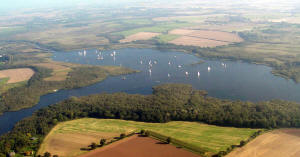
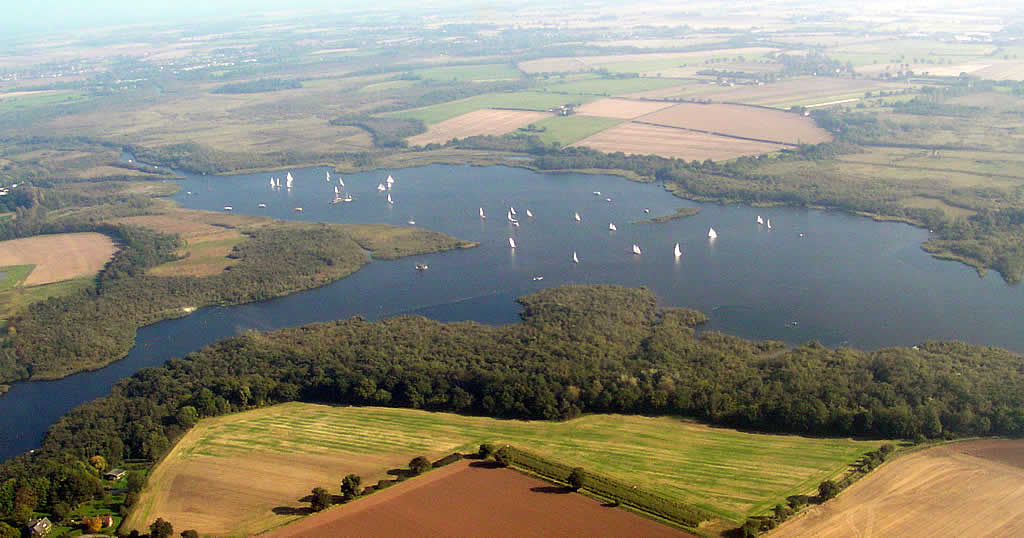
Aerial View of Barton
Broad
In total there are 63
broads. Most of these lie in the northern section and
are linked to the rivers Thurne,
Ant and
Bure. However, there are
also a number of Broads further south linked to the
River Yare - such as
Rockland and
Surlingham. In
addition, there is also Oulton Broad which lies over the
border in Suffolk.
G. Christopher Davies (1849-1922)
The Norfolk Broads as a holiday
destination was popularised, in large part, by G. Christopher Davies in his books
The Handbook to the Rivers
and Broads of Norfolk and Suffolk. The handbook
was first published in 1882 and subsequently ran for fifty editions. Here is a beautiful
description of wherries which used to carry cargoes
through the Broads:
|
|
'No Broad scene would be complete without the presence of
a wherry, which is perhaps the most picturesque and
graceful of all sailing goods-carrying craft, and
certainly the swiftest and handiest of all which voyage
on smooth waters. The course of the river through the
green marshes is, where the water is itself invisible,
marked by the tall high-peaked sails of these craft,
which seem to be gliding along the land itself.' |
|
However, Davies was aided by the fact that new railway
lines (The Great Eastern) were opening up the county.
The line to
Norwich arrived in1844. His work also coincided with the
increase in leisure time and the beginnings of mass
tourism.
Davies was also a novelist and wrote the children's
book The Swan and Her Crew which is set at
Hickling. This tale of boys
and boats was obviously a major influence upon the work
of Arthur Ransome.
|
Hugh Money-CouttsIn 1919 Money-Coutts
published an account, in verse, of a tour through the
Norfolk Broads entitled The Broads. The quality
of the poetry may not have been tip-top but the
topographical details are fascinating:
|
On Breydon Water, when the tide is out,
The channel bounds no sailorman can doubt
Starboard and port, the miry banks reveal
Where safety lies beneath its cautious keel.
But when the flood has wiped the water clean,
- Hiding the muddy haunts where seagulls preen
Their wings, and shake their heads - black pillars mark
The channel's edge for each adventuring bark. |
|
Arthur Ransome (1884-1967)
Arthur Ransome visited the area in the 1930s and soon
began to use the area as inspiration for his childrens'
books Coot Club (1934) and The Big Six
(1940).
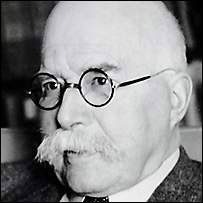
Arthur Ransome
Both of these stories centre upon the village of
Horning. Ransome was knowledgeable about both sailing and
the bird life of the Broads and his descriptions are
detailed and affectionate. Here is a passage from
Coot Club, which bears some resemblance to Davis'
description above:
|
|
'And so, rejoicing in their freedom, the outlaw and his
friends sailed on their way, through a country as flat
as Holland, past huge old windmills, their sails
creaking round, pumping the water from the low-lying
meadows on which the cows were grazing actually below
the level of the river. Far away over the meadows, other
sails were moving on Ant and Thurne, white sails of
yachts and big black sails of trading wherries.' |
Interestingly, Ransome seems to have been aware that it
would be the coming of the motor-cruisers that would
spoil the pristine wilderness
of the Broads. In Coot Club - it is the noisy,
uncouth 'Hullabaloos' aboard the Margoletta who
are the villains of the story. They disregard the speed
limits, cut up the sailing boats and spend much of their
time in the riverside pubs - when not pursuing Tom, Dick
and Dorothea along the River Bure. Our heroes, in
contrast, navigate the water ways in the gentle,
wind-powered Teasel.
Soon would come the explosion of the Broads holiday trade
and the deterioration of the environment - a far cry from P. H.
Emerson's nineteenth century photographs of reed
cutters and marshmen. The escape of coypu into the
Broads also had a part to play in bank erosion - a
problem which was greatly exacerbated by the wash from
the cruisers. |
|
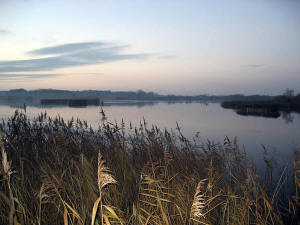
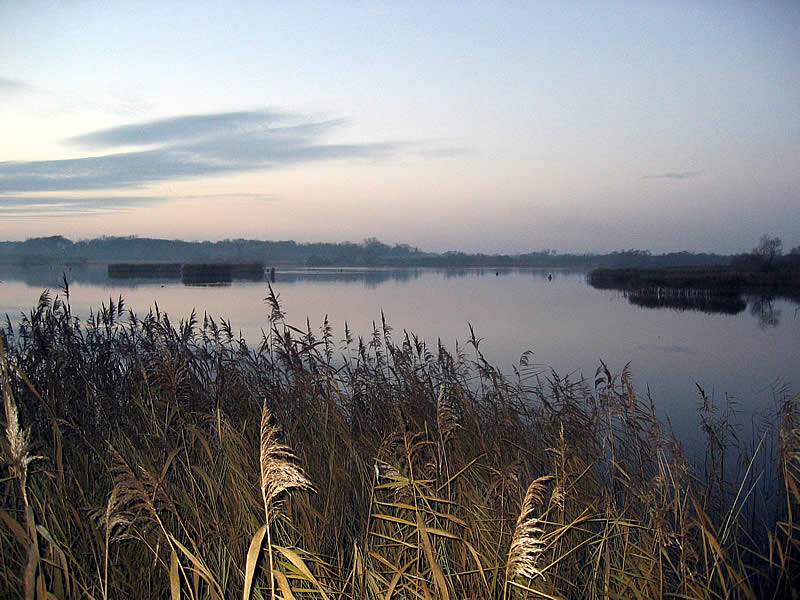
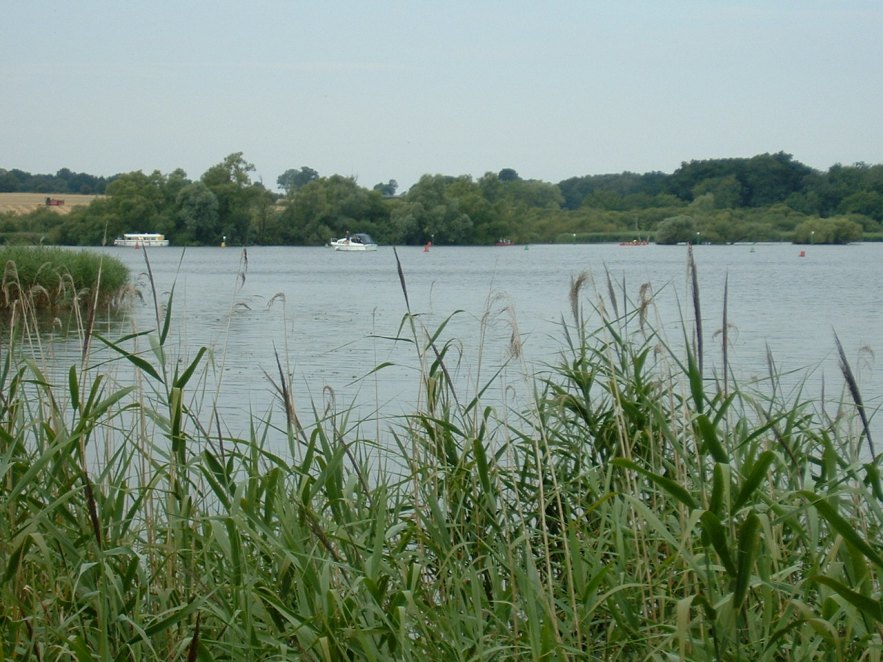
Rockland Broad
 |
|
John Betjeman (1906-84) As a child Betjeman
used to visit the Broads with his father and, later in
life, reminiscences of these holidays inspired two of
his finest poems
East Anglian Bathe - which is set at
Horsey and
Norfolk - which
recalls his time aboard his father's yacht the 'Queen of
the Broads' and contains the evocative lines 'The
lap lapping of the weedy Bure,/A whispering and watery
Norfolk sound'.
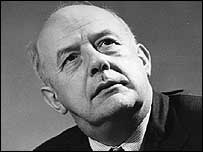
Sir John Betjeman
In fact, Betjeman has admitted that it was the view
of St Peter's church at Belaugh
from his father's boat which first inspired his love of
churches.
|
|
Alan Hunter (1922-2005) Hunter is best know for
his series of detective novels featuring the stoic
Inspector Gently. Hunter, who was born and brought up in
Hoveton, tried his hand at
both poetry and plays before settling down to write over
40 crime novels starring his eponymous hero. A number of
the stories are set in the Norfolk Broads including
Gently Down Stream and Gently Floating.
In his 1944 collection of poetry (entitled Norwich
Poems) there is charming piece about holidaymakers
arriving in Wroxham and
rushing round to gather all the provisions they need for their
week afloat:
Saturday at Wroxham.
Hunter's detective novels were recently adapted by
the BBC but, unfortunately, the original Broads location
was changed to Northumberland. In the programme,
Inspector George Gently was played by Martin Shaw.
|
|
George MacBeth (1932-92) In 1979 the poet George MacBeth
moved to the Old Rectory at Oby. The house is situated
on a slight rise overlooking the low-lying land and
marshes of the River Bure and River Thurne. This unique
landscape inspired him to write his collection Poems
from Oby. Here is the first verse of his poem
Yuletide in Norfolk:
|
The long-ships drove up the Bure, and the horned men
were
there to rape and to burn,
Seeding their names, Rollesby and Billockby, Fleggburgh,
Clippesby and Thurne,
Ashby and Oby. Our church roofs came from the rot of
each
oak-warped stern.Read complete
poem |
|
One of the best views of Broadland can be obtained from
the top of the tower of St. Helen's Church at
Ranworth -
sometimes referred to as 'the cathedral of the broads'.
The tower has 89 uneven steps - followed by two ladders
and a heavy trap door which gives access to the roof.
Once outside, there is a magnificent view of both
Malthouse and Ranworth
Broad. It was on Ranworth Broad that Dick and Dorothea
in Coot Club first learn to sail. Further a field can be seen St. Benet's Abbey -
not to mention hundreds of church spires. With the
aid of binoculars, it is also possible to see
Happisburgh
lighthouse and the spire of Norwich Cathedral.
Today the Broads Authority is eager to promote the area
as a centre for sustainable tourism and is therefore
encouraging the use of electric boats.
Other writers who have been inspired by the Broads
include: Mark Cocker (Buckenham),
James Blyth (Fritton), Gladys
Mitchell (Ranworth), Wilkie
Collins (Horsey), Arthur
Patterson (Breydon Water), Ted Ellis (Surlingham)
and Chris Crowther (Hoveton).
|
Links:
More photographs of the Norfolk Broads
|
|
|
|

 Supported
by Norfolk Tourism
Supported
by Norfolk Tourism