Potter Heigham
Potter Heigham is located in the heart of the
Norfolk
Broads on the River Thurne.
Sidney Grapes (1888-1958)
Sidney Grapes, the Norfolk humorist, lived in the village
for most of his life. Originally he owned a cycle shop
(located next to the River Thurne) but, with the coming
of the age of the car, he transformed this into a
garage. He used to live in a flat
above the 'shop' with his wife Ella.
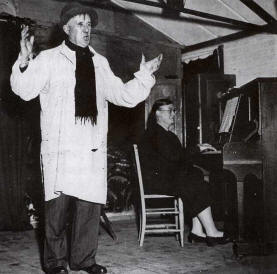
The Late Great Sidney
Grapes
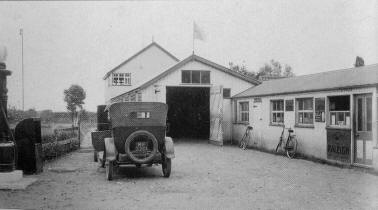
Grapes' Garage c. 1924
One December he displayed a notice outside his garage
which read: ' A merry Chritmas to all my customers wot
ha' paid their bills, and a prosperous New Year to them
wot hain't.' He continued to develop this humorous use
of the Norfolk dialect until, in 1946, he wrote his
first letter to the The
Eastern Daily Press (EDP) signed 'The Boy John'.
For the next 12 years
The Boy John Letters
appeared intermittently in the EDP and became something
of a Norfolk institution. They detailed the goings on (as narrated by the Boy
John) of various engaging Norfolk
village characters
including Aunt Agatha, Granfar and Mrs W. The letters
were full of humour and good sense and are particularly
remembered for Aunt Agatha's aphorisms which concluded
each instalment - such as: 'Aunt Agatha, she say: All
husbands are alike, only they have different faces so
you can tell 'em apart.'
Here is one of the early letters entitled Aunt
Agatha's Dickey Ride (a 'dickey' being Norfolk
dialect for Donkey).
|
|
Dear Sar - Well, the time a' cum round agin for me
and Arnt Agatha and Granfar, to rite an wish yow, and
yar starf an orl, a werry Happy Christmas. Arnt Agatha,
she say, specially to that there gentleman wot go about
a taken them photos o' pretty plearces in Norfolk, he
must a' got a bike, to git about like he dew.
Oh! I must tell you about Arnt Agatha, last summer.
We had a garden fate at the Wickerage, an weeks
afore-hand you could buy shillin tickets, then save em
all up, then spend em on anything at the fate. Well Arnt
Agatha, she was wery busy and dint git there till ever
so late, an then ewerything wus sold. She had six
shillin tickets wot she'd saved, an orl she could spend
em on wus on six shilling rides round the field on the
Wicar's owld dicker, wot he's lent for the purpus. Well
bor she cum home orl o' a muckwash - she looked a job.
Granfar, he mobbed har, and he called har a silly old
fule. He fear to ha been a pearkin tru a hole in the
fence and see har. He say, "There she wus a bobbin up
and down on that old dicker's back, a' holden har hat on
wi one hand, an har teeth in wi the tother, she look
disgustin."
Poor Granfar, he about about everything nowadays. He go
down to the pub every nite, he come back a mobbin about
the beer, he say he's right glad when he a' had enuf on
it. Arnt Agatha say, "Well yow put em in," he say, "I
never put them in, I votted learbor. Well fare
you well together, a Happy Xmas to all you wot read this
- Yours obediently,
THE BOY JOHN
P.S. - Arnt Agatha she say, If you dorn't git orl you
want, think of the things yow dorn't want - an dorn't
git. |
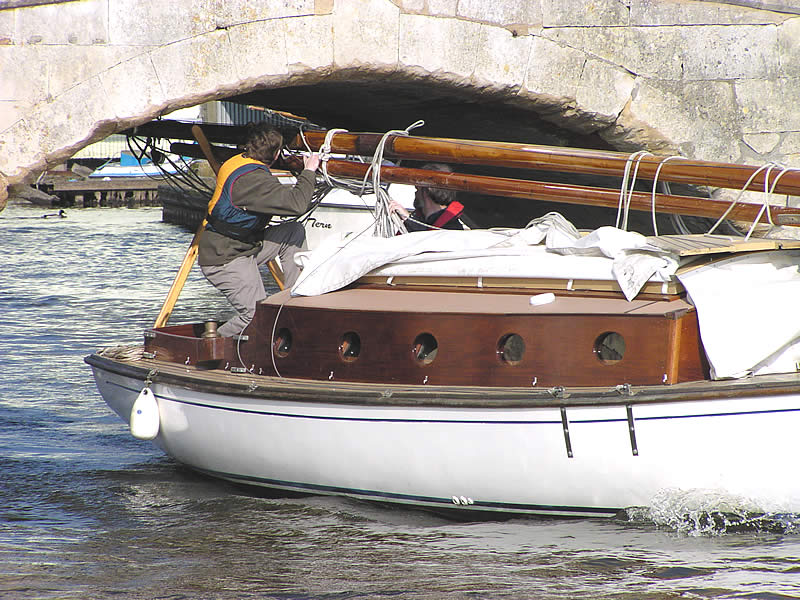
In fact, the base of the stone bridge at Potter Heigham
was built in about 1380 and the parapets were added at a
later date. The bridge is one of the best known
landmarks in the Broads. It is only possible to pass
through the central arch of the bridge and even
small vessels sometimes struggle to get through - as
the numerous streaks of
paint on the inside of the bridge testify.On their
way back from Horsey, the Teasel moors up in the
dark at Potter Heigham and the children fail to notice
that they are actually right next to the Margoletta
- which they are desperately trying to avoid. In the
sequel to Coot Club - The Big Six - the
Death and Glories (alias Joe, Bill and Pete) catch a 30½
pike just up stream of Potter Heigham close to Kendal
(Candle) Dyke. The pike is taken to Norwich to be stuffed and is
later displayed on the mantelpiece of the Roaring Donkey
pub.
|
Potter Heigham Ghost StoriesThe village is
also associated with two ghost stories: The Phantom
Coach of Potter Heigham and The Ghostly Drummer.
In the first story Lady Carew and her daughter Evelyn
swear away their souls in return for a love potion to
ensnare the eligible bachelor Sir Godfrey Haslitt. The
love potion works and Evelyn and Haslitt are married in
1742. However,on the night of their nuptial blessing a
phantom coach appears - driven by skeletons and takes
the bride away. The coach bursts into flames as it
crosses Potter Heigham bridge.
In the second story a drummer boy - home on leave
from the army - falls in love with a girl from the
village. Unfortunately the girl's father refuses to
accept a soldier as a son-in law and so the couple are
forced to meet in secret at Swim Coots on Hickling
Broad. Every February the drummer boy would skate across
the broad to meet his love - but one evening the ice
gives way and he is drowned. Today, apparently, his
ghost can be seen on the broad during the month of
February accompanied by the sound of ghostly drumming.
|



 Supported
by Norfolk Tourism
Supported
by Norfolk Tourism