|
|
|
|
The River Waveney
Were I in my
castle
Upon the River Waveney,
I wouldne give a button
For the King of Cockney.
(Hugh the Bold 1173) The River Waveney rises at Redgrave Fen and then flows
eastward towards Great Yarmouth. For much of its course
it provides the border between Norfolk and Suffolk -
however just south of St Olaves the border turns right
to follow the southern side of Fritton Decoy and the
Waveney flows on to Breydon Water.
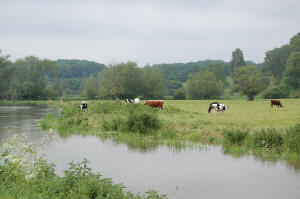
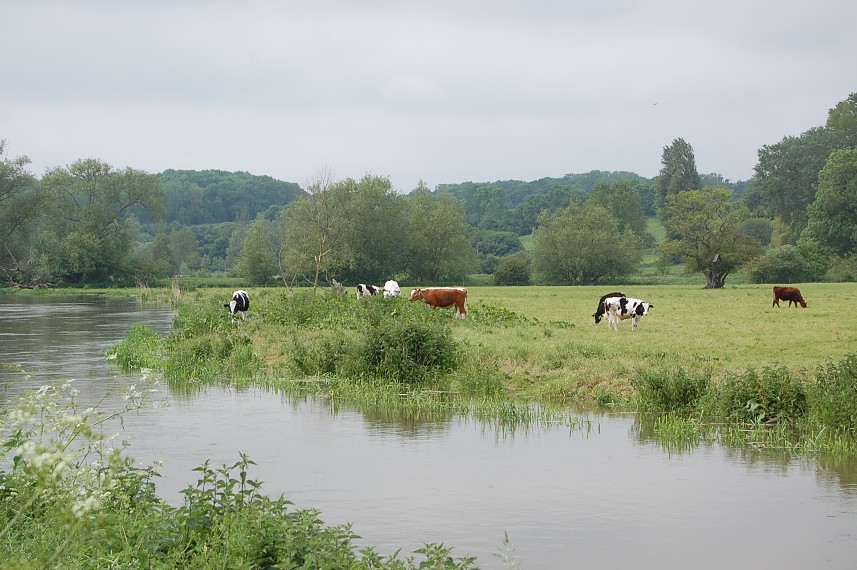
River Waveney at Bungay Common The Lincolnshire poet Jean Ingelow (1820-1897) wrote a charming
poem called The Waveney about the
river in its upper reaches.
|
|
The Waveney Listen
to me -
There is a little river, fed by rills
That winds among the hills,
And turns and suns itself unceasingly,
And wanders through the cornfields wooingly,
For it has nothing else to do, but play
Along its cheery way:
Not like great rivers that in locks are
bound,
On whom hard man doth heavy burdens lay,
And fret their waters into foam and spray.
This river's life is one long holiday
All the year round.
Listen and long -
It hears the bells of many churches chime,
It has a pleasant time:
The trees that bow to it their branches
strong,
Hide many birds that make its spring one
song,
And orchard boughs let fall their flowery
wealth,
To float away by stealth,
And land in tiny coves a mile below,
Or round and round the stems of rushes veer
Like snowy foam, but truly none is here,
So calmly gurgle on the waters clear
With endless flow. |
|
The nature writer
Richard Mabey now lives at Roydon. He
moved here after fifty years living in his family home
in the Chiltern hills. The move to Norfolk helped him to
recover from clinical depression and inspired his moving
memoir Nature Cure (2005). The book deals
candidly with his illness and how the flat, watery lands
of Norfolk helped to reconnect him again with the
natural world. During the worst period of his illness,
he was confined to the same hospital in Northampton as
the poet John Clare. Mabey is friendly with Mark
Cocker - another talented nature writer - who lives at
Claxton in the Yare valley.
After Roydon, the
river flows past the market town of
Diss - where the poet John Skelton was once the
rector of St. Mary's Church. It then heads on past
Redenhall - where the
playwright Arnold Wesker found inspiration for his play
Roots. The painter Sir Alfred Munnings was born
at Mendham on the Suffolk side of the river in 1878. He
was the son of the local miller and moved to Norwich at
the age of 14 to train as a poster designer. He was
inspired by the scenery of the Waveney valley and is
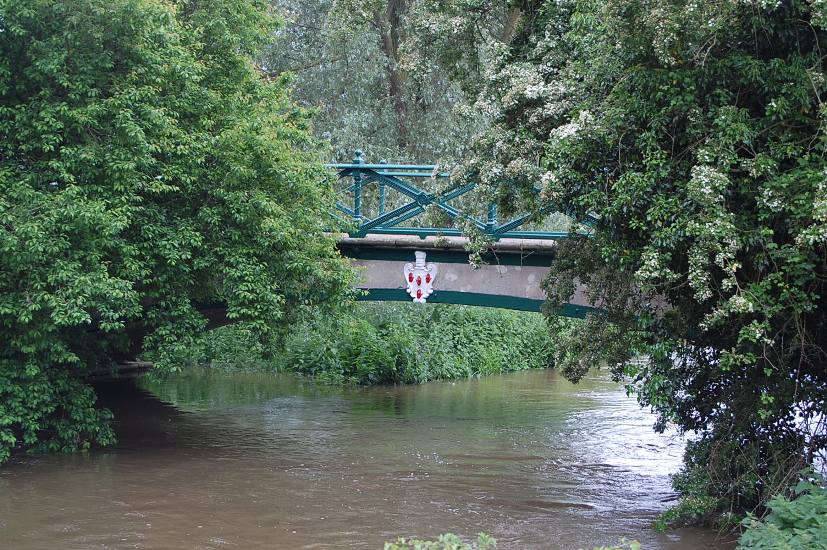
particularly remembered for his paintings of horses. At Homersfield there is a unique
concrete bridge - which was the first to be built
anywhere in the UK.
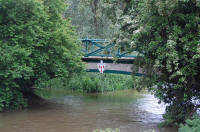
Homersfield Bridge At Bungay the river circles Outney
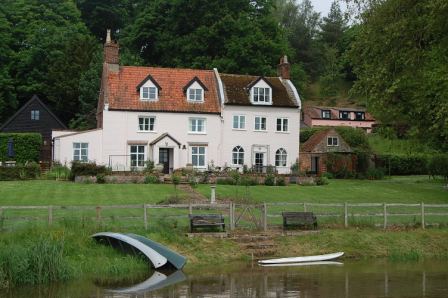
Common in a large loop and is overlooked by The Bath
House - a large white cottage which was once owned by Lilias Rider Haggard
- the daughter of Sir Henry Rider Haggard. The Haggard
family also owned nearby Ditchingham
House. Lilias was a talented writer in her own right and
was the author of a trilogy of books about the county:
Norfolk Life, Norfolk Notebook and
Country Scrapbook - written during and after
WW2. Most of the essays in these books originally
appeared in the Eastern Daily Press.
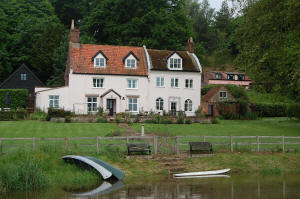
The Bath House
Here is a wonderful description of the winter Waveney
at Bungay Common from Norfolk Life:
|
|
'The snow-flood is coming down the river, and a steadily
rising tide of turbid water creeps over the marshes.
This afternoon the Common lay without sound, a flat,
grey expanse up to the low hills on the horizon, where
the woods lie black against the sky. Behind them the
sun, a furious ball, was sinking through a pall of mist.
A solitary swan was moving in the sunset waters of the
river.' |
|
Bungay is also the home of the novelist Elizabeth Jane
Howard. Howard, who has published many novels, is
probably best known for her Cazalets Chronicles.
Her autobiography Slipstream dealt candidly with
her various love affairs and marriages. She was
originally married to the naturalist Peter Scott and
then later to fellow novelist Kingsley Amis. She
famously had affairs with Cecil Day-Lewis, Laurie Lee,
Cyril Connolly and the theatre critic Kenneth Tynan.
Another author with a close connection to the river was
the nature writer Roger Deakin (1943-2006). Deakin, who
lived in a moated Elizabethan farmhouse at Mellis Common
near Diss, was well known as a wild swimmer. His book
Waterlog (1999) was an account of his swimming
expeditions through out Britain and the Waveney
was one of his favourite locations:
|
|
'With its secret pools and occasional sandy beaches, the
Waveney is full of swimming holes, diving stages
improvised from wooden pallets, dangling ropes, and
upturned canoes pulled up on the bank. Every two or
three miles you come to a weir and a whitewashed
watermill.' |
|
The river becomes navigable at Geldeston and then passes
through Beccles. In Arthur Ransome's Coot Club, the children and Mrs Barrable
sail up the Waveney from
Yarmouth in the Teasel and moor at Beccles. On their way back they
enter Oulton Broad but are caught in a bad storm.
The novelist James Blyth,
who lived at Fritton, set many
of his works against the background of the River Waveney
- in particular its reed beds and wide flood plain.
Shortly after Fritton, the Waveney merges with the
River
Yare at Breydon Water.
|
|
More photographs of the River Waveney |
|
|
|

 Supported
by Norfolk Tourism
Supported
by Norfolk Tourism